
コンクリートはなぜ塗装するのか?

コンクリートはなぜ塗装するのか?
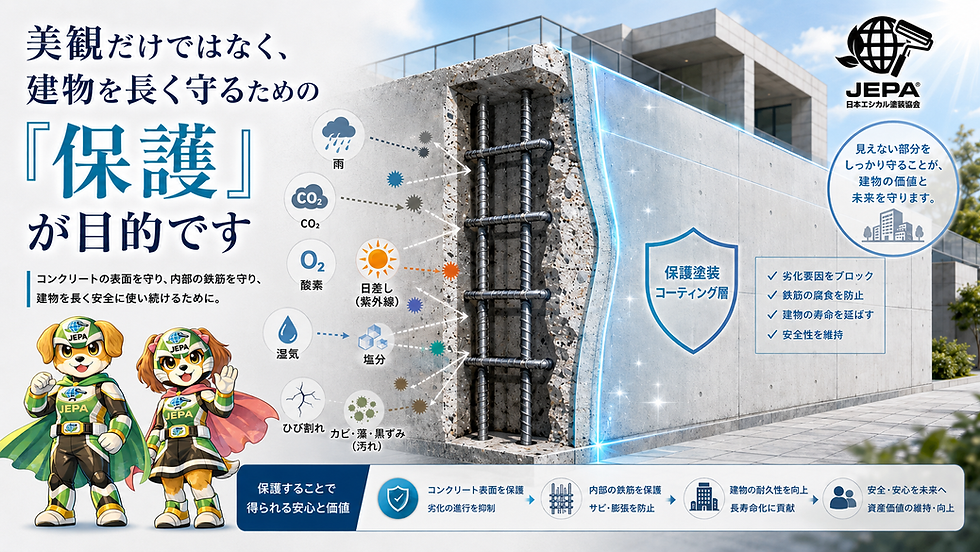
美観だけではなく、建物を長く守るための「保護」が目的です
コンクリートの建物や壁を見ると、多くの方は「丈夫そう」「石のように長持ちしそう」と感じるかもしれません。
たしかに、コンクリートは建物を支える大切な材料です。しかし、コンクリートは何もしなくても永久に同じ状態を保てる材料ではありません。
コンクリートはなぜ塗装するのか?雨、空気中の二酸化炭素、酸素、日差し、温度変化、湿気、塩分、ひび割れ、カビ・藻・黒ずみなどの生物由来の汚れ。こうしたさまざまな影響を受けながら、コンクリートは少しずつ変化していきます。
では、なぜコンクリートに塗装や保護が必要なのでしょうか。
その理由は、単に見た目をきれいにするためだけではありません。コンクリートの表面を守り、内部の鉄筋を守り、建物を長く安全に使い続けるためです。
コンクリートは、最初は強いアルカリ性を持っています
鉄筋コンクリートの中には、鉄筋が入っています。
鉄は、そのまま水や酸素に触れると錆びやすい材料です。しかし、コンクリート内部はもともと強いアルカリ性を持っているため、鉄筋の表面には「不動態被膜」と呼ばれる保護膜ができ、鉄筋が錆びにくい状態に保たれています。
つまり、コンクリートはただ鉄筋を包んでいるだけではありません。高いアルカリ性によって、鉄筋を錆から守る役割も持っているのです。
一般社団法人コンクリートメンテナンス協会では、高アルカリ環境のコンクリート中にある鉄筋表面には不動態被膜が形成される一方、pHが概ね11より低くなると不動態被膜が破壊され、鉄筋が腐食環境に置かれると説明されています。参考:一般社団法人コンクリートメンテナンス協会「中性化とは」https://www.j-cma.jp/?cn=102637
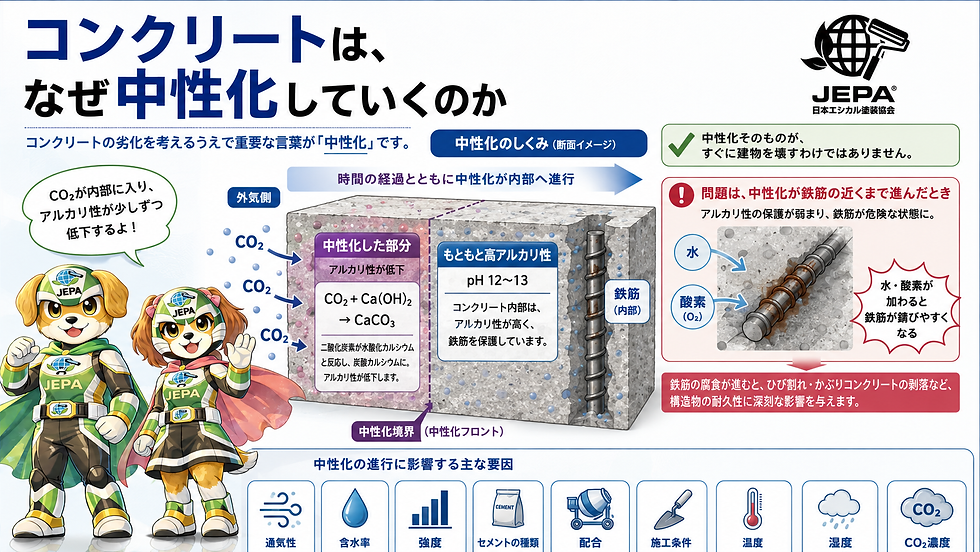
コンクリートは、なぜ中性化していくのか
コンクリートの劣化を考えるうえで重要な言葉が「中性化」です。
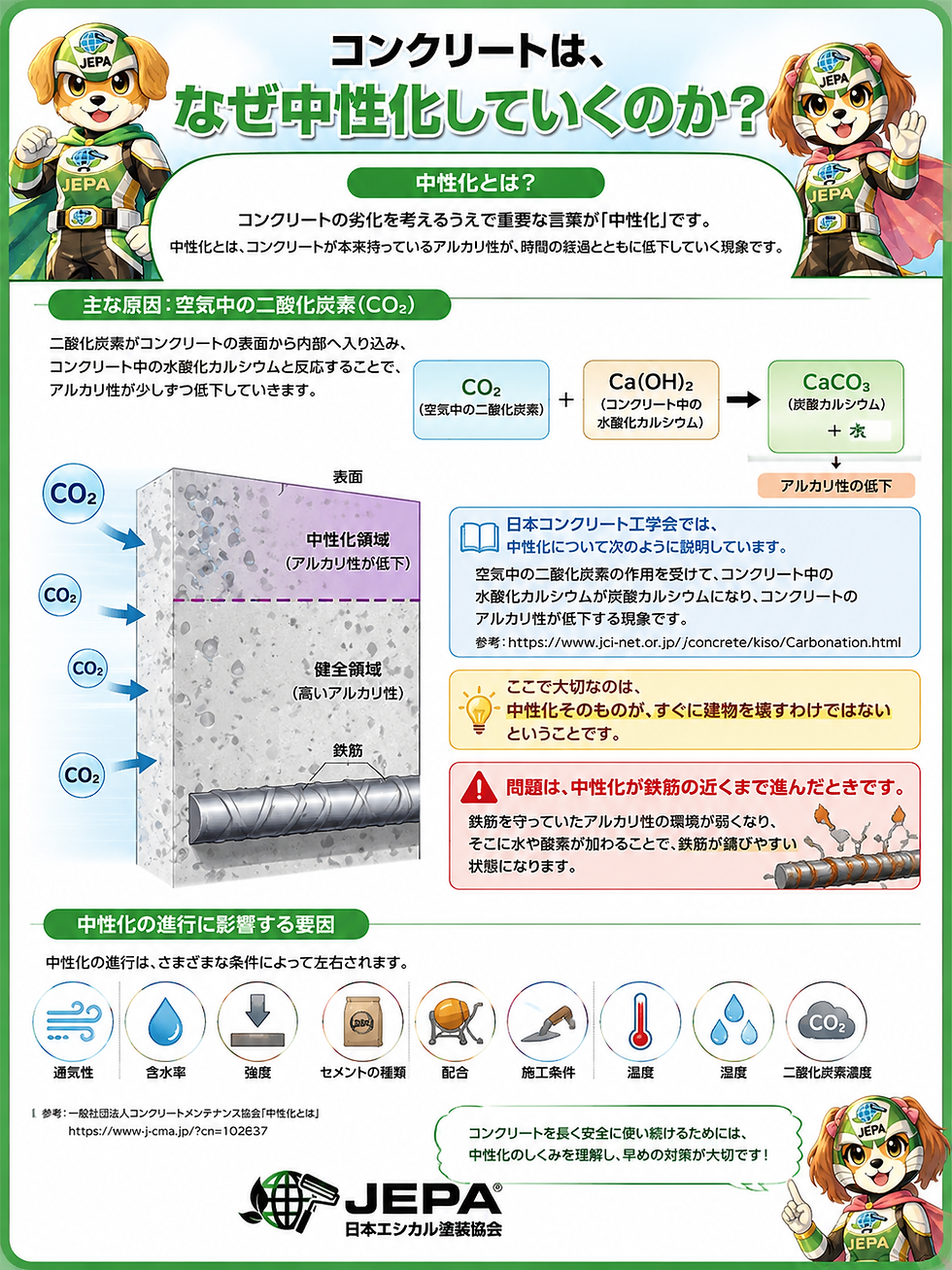
中性化とは、コンクリートが本来持っているアルカリ性が、時間の経過とともに低下していく現象です。
主な原因の一つは、空気中の二酸化炭素です。二酸化炭素がコンクリートの表面から内部へ入り込み、コンクリート中の水酸化カルシウムと反応することで、アルカリ性が少しずつ低下していきます。
日本コンクリート工学会では、中性化について、空気中の二酸化炭素の作用を受けてコンクリート中の水酸化カルシウムが炭酸カルシウムになり、コンクリートのアルカリ性が低下する現象と説明しています。参考:日本コンクリート工学会「コンクリートの基礎知識:中性化」https://www.jci-net.or.jp/j/concrete/kiso/Carbonation.html
ここで大切なのは、中性化そのものが、すぐに建物を壊すわけではないということです。
問題は、中性化が鉄筋の近くまで進んだときです。鉄筋を守っていたアルカリ性の環境が弱くなり、そこに水や酸素が加わることで、鉄筋が錆びやすい状態になります。
中性化の進行は、コンクリートの通気性、含水率、強度、セメントの種類、配合、施工条件、温度、湿度、二酸化炭素濃度などにも影響を受けるとされています。参考:一般社団法人コンクリートメンテナンス協会「中性化とは」https://www.j-cma.jp/?cn=102637
鉄筋が錆びると、コンクリートは内側から壊れていく
鉄筋が錆びると、錆は元の鉄よりも体積が大きくなります。
その膨張する力によって、周囲のコンクリートが内側から押され、ひび割れが発生します。さらに、そのひび割れから雨水や酸素が入りやすくなると、鉄筋の腐食はさらに進みます。
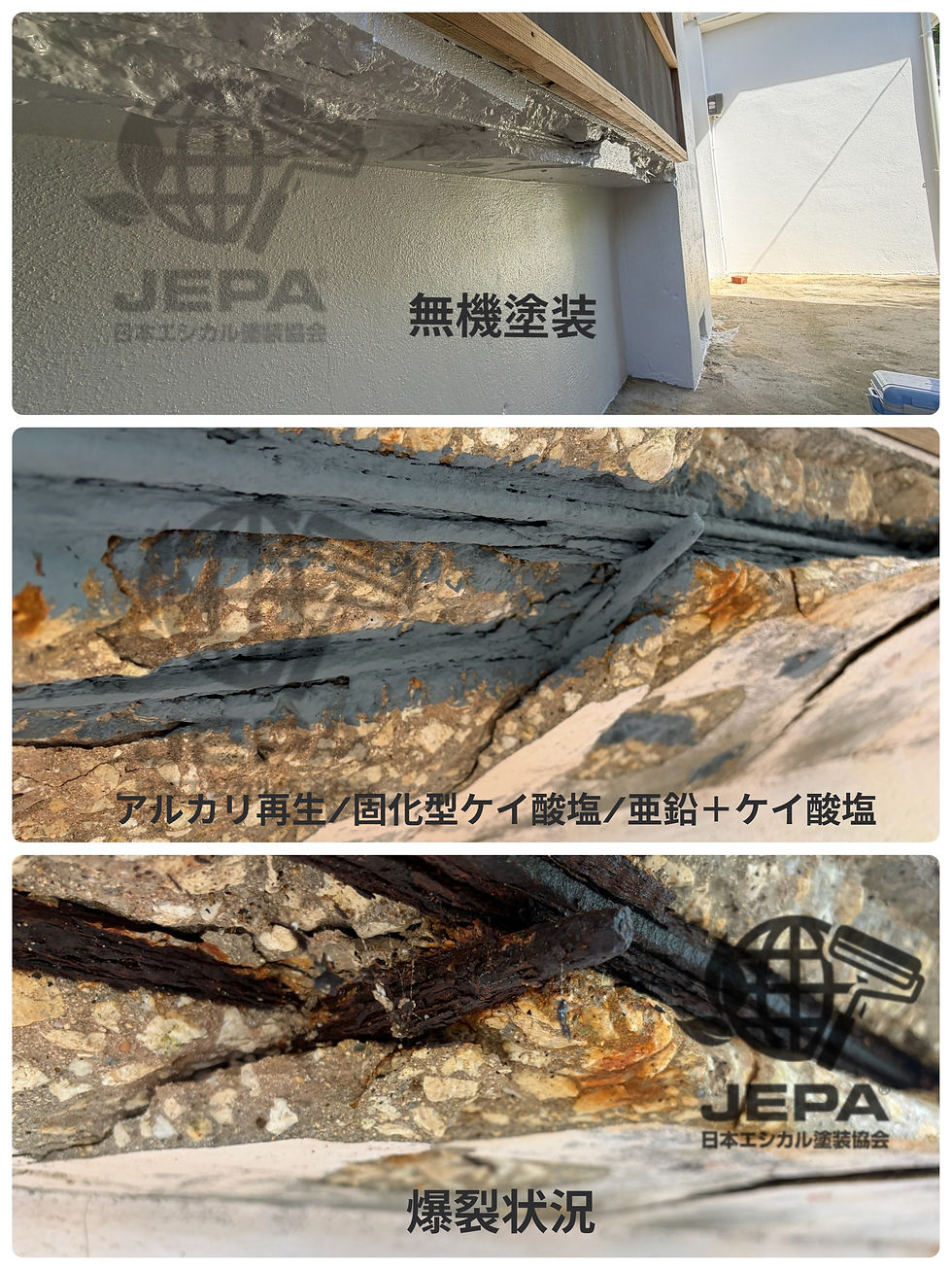
その結果、コンクリートの浮き、剥離、爆裂、剥落といった現象につながることがあります。
コンクリートメンテナンス協会の解説でも、鉄筋が腐食すると体積膨張によってコンクリートにひび割れが発生し、そのひび割れを通じて水分や酸素などの劣化因子の供給が容易になり、剥離・剥落や鉄筋断面の減少につながるとされています。参考:一般社団法人コンクリートメンテナンス協会「中性化とは」https://www.j-cma.jp/?cn=102637
つまり、コンクリートの表面に見えている小さなひび割れや錆汁は、内部で起きている劣化のサインである可能性があります。
塗装は、コンクリートを劣化因子から守る保護層です
コンクリート塗装というと、色を塗って見た目をきれいにする工事と思われがちです。
もちろん、美観を整えることも大切です。しかし、本来の大きな目的は、コンクリートの表面に保護層をつくり、雨水、二酸化炭素、酸素、塩分などの劣化因子が内部へ入り込むのを抑えることです。
中性化の補修工法に関する技術解説では、表面保護工法によって二酸化炭素の侵入が低減されると、中性化領域の進展を抑制し、水分や酸素の侵入も併せて抑えることができると説明されています。参考:一般社団法人コンクリートメンテナンス協会「中性化の補修工法」https://www.j-cma.jp/?cn=102639
つまり、コンクリート塗装は「見た目のため」だけではなく、建物の寿命を延ばすための保護工事でもあるのです。
洗浄だけでは、また汚れが戻ることがあります
コンクリートの表面が黒ずんでいる場合、高圧洗浄などで一時的にきれいに見えることがあります。
しかし、洗浄はあくまで表面に付着した汚れを落とす作業です。コンクリートそのものが中性化していたり、表面が脆くなっていたり、水分を吸いやすい状態になっていたりする場合は、時間が経つと再び汚れが付きやすくなることがあります。
特に、雨が当たりやすい場所、日当たりが悪い場所、湿気が残りやすい場所では、黒ずみ、カビ、藻、微生物由来の汚れが発生しやすくなります。
ここで大切なのは、「汚れを落とすこと」と、「汚れにくい状態へ整えること」は違う、ということです。
洗浄は、今ある汚れを落とす作業です。一方で、特殊コーティングや表面保護は、今後の汚れや劣化因子の侵入を抑えるための作業です。
下地を整え、特殊コーティングで保護するという考え方
コンクリート改修では、表面をきれいにするだけではなく、下地の状態を整えることが重要です。
劣化したコンクリートでは、表面だけでなく、内部の状態そのものが変化している可能性があります。本来のアルカリ性が低下していたり、水分を吸いやすくなっていたり、ひび割れから劣化因子が入りやすくなっていたりすることがあります。
そのため、必要に応じて、コンクリート表面の状態を整えたうえで、特殊コーティング剤や表面保護材を使用します。
このような保護処理には、次のような目的があります。
汚れを付きにくくすること。黒ずみの再発を抑えること。水分を入りにくくすること。二酸化炭素や酸素などの劣化因子を入りにくくすること。中性化や鉄筋腐食の進行を抑えること。コンクリートを長く健全な状態に近づけること。
つまり、コンクリートを守る工事は、ただ上から色を付けるだけではありません。劣化によって変化したコンクリートの状態を確認し、必要に応じて下地を整え、保護しやすい状態へ近づける作業でもあります。
専門的には、このような考え方を「下地改質」や「表面保護」と呼ぶことがあります。劣化した部分をただ隠すのではなく、コンクリート表層の状態を整え、鉄筋腐食や水分侵入が進みにくい状態へ近づけてから、塗装や保護を行うという考え方です。
日本コンクリート工学会では、シラン系表面含浸材について、施工が簡易で無色透明であり、コンクリート構造物の予防保全対策や経年劣化に対する補修工法として広く適用されていると紹介しています。参考:日本コンクリート工学会「シラン系表面含浸材について」https://www.jci-net.or.jp/j/concrete/technology/201906_article_1.html
また、表面含浸工法には、撥水型のシラン系表面含浸材や、緻密化型のけい酸塩系表面含浸材などがあり、目的や下地の状態に応じて使い分ける考え方があります。参考:リナック技研「シラン系表面含浸材とけい酸塩系表面含浸材の比較」
半年後に差が出る、洗浄だけと保護コーティングの違い
施工直後は、洗浄だけでも表面がきれいに見えることがあります。
しかし、半年後、1年後と時間が経つと、汚れの付き方に差が出ることがあります。
洗浄だけの面は、表面の汚れを落としただけなので、コンクリート表面が水分や汚れを受けやすい状態のままである場合があります。そのため、雨水や湿気、空気中の汚れ、微生物由来の汚れによって、再び黒ずみが出やすくなることがあります。
一方で、下地を整え、特殊コーティングによる表面保護を行った面は、水分や汚れが入り込みにくくなり、黒ずみや汚れの付着を抑えやすくなることがあります。
もちろん、環境条件や下地の状態、使用する材料、施工方法によって結果は変わります。しかし、洗浄だけの場合と、下地改質・表面保護を組み合わせた場合では、時間が経った後の美観や保護性能に差が出ることがあります。
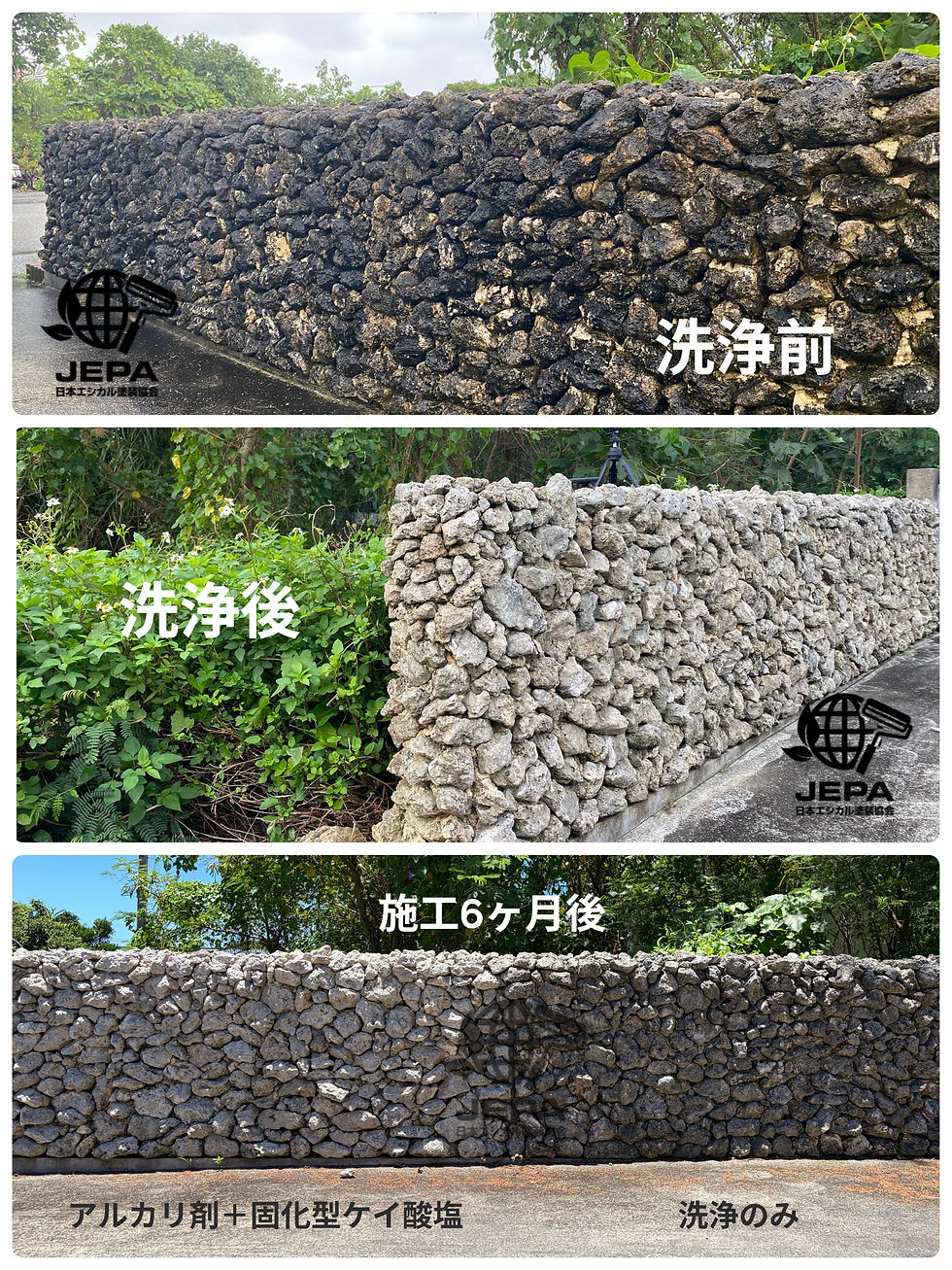
ここに、実際の比較写真を入れると分かりやすくなります。
【写真挿入位置】左:洗浄のみを行ったコンクリート面右:下地を整え、特殊コーティングによる表面保護を行ったコンクリート面
施工後、一定期間が経過すると、汚れや黒ずみの付き方に違いが見られる場合があります。表面保護は、美観を保つだけでなく、水分や二酸化炭素などの劣化因子の侵入を抑える目的でも行われます。
(湿気が多い宮古島市で防汚調査のテスト施工写真)
すでに劣化している場合は、塗るだけでは不十分なこともあります
ここで注意したいのは、すでに劣化が進んでいるコンクリートに、ただ上から塗装すればよいわけではないということです。
例えば、次のような症状がある場合は注意が必要です。
ひび割れがある。錆汁が出ている。表面が浮いている。コンクリートが欠けている。鉄筋が見えている。爆裂や剥落が起きている。
このような場合、表面をきれいに塗る前に、まず下地の状態を確認する必要があります。
劣化の状態によっては、脆くなった部分の除去、鉄筋の錆処理、防錆、断面修復、ひび割れ補修、表面含浸材や表面被覆材の選定など、適切な補修工程が必要になります。
また、日本コンクリート工学会の近年の解説では、中性化によるpH低下や塩化物イオンの侵入は腐食の起点になり、その後の腐食進行は水と酸素の作用の仕方に左右される可能性が高いと整理されています。参考:日本コンクリート工学会「コンクリート中の鉄筋腐食に関する解説」https://www.jci-net.or.jp/j/concrete/technology/202407_article_2.html
つまり、コンクリート改修では、「汚れているから洗う」「古くなったから塗る」だけでは不十分なことがあります。
大切なのは、今のコンクリートがどのような状態なのか。中性化が進んでいるのか。水分を吸いやすくなっているのか。鉄筋腐食が始まっているのか。表面保護だけでよいのか。下地改質や補修が必要なのか。
これらを確認したうえで、適切な工事を選ぶことです。
コンクリートを守ることは、建物を長く使うことにつながる
コンクリート塗装や表面保護は、単なる美観工事ではありません。
雨水、二酸化炭素、酸素、塩分、汚れ、微生物由来の黒ずみなどからコンクリートを守り、内部の鉄筋腐食や爆裂、剥落のリスクを抑えるための保護技術です。
そして、建物を長く使うことは、資源を無駄にしないことにもつながります。
壊れてから直す。傷んでから慌てて補修する。それだけではなく、劣化の原因を理解し、早めに守ること。
これが、これからのコンクリート保護に必要な考え方です。
(宮古島市の塩害地域でみられる天井の爆裂補修調査と保護調査の施工テスト写真)
まとめ
コンクリートを塗装する理由は、見た目をきれいにするためだけではありません。
コンクリート表面を保護し、雨水、二酸化炭素、酸素、塩分などの劣化因子の侵入を抑えることで、中性化や鉄筋腐食の進行を抑え、建物を長く使い続けるためです。
また、黒ずみや汚れが目立つ場合も、洗浄だけで終わらせるのではなく、下地の状態を確認し、必要に応じて特殊コーティングや表面保護を行うことで、汚れにくく、劣化しにくい状態へ近づけることができます。
コンクリート塗装は、きれいに見せるためだけの工事ではありません。建物を長く守るための「保護技術」です。
次回は、今回少し触れた「中性化」について、もう少し詳しく解説します。
なぜコンクリートはアルカリ性なのか。なぜ空気中の二酸化炭素によって中性化が進むのか。そして、中性化が進むと、鉄筋にどのような影響があるのか。
専門的な内容も交えながら、できるだけ分かりやすくお伝えします。
参考文献・参考資料
一般社団法人コンクリートメンテナンス協会「中性化とは」https://www.j-cma.jp/?cn=102637
一般社団法人コンクリートメンテナンス協会「中性化の補修工法」https://www.j-cma.jp/?cn=102639
公益社団法人 日本コンクリート工学会「コンクリートの基礎知識:中性化」https://www.jci-net.or.jp/j/concrete/kiso/Carbonation.html
公益社団法人 日本コンクリート工学会「シラン系表面含浸材について」https://www.jci-net.or.jp/j/concrete/technology/201906_article_1.html
公益社団法人 日本コンクリート工学会「2024年7月号 コンクリート中の鉄筋腐食に関する解説」https://www.jci-net.or.jp/j/concrete/technology/202407_article_2.html
リナック技研株式会社「シラン系表面含浸材とけい酸塩系表面含浸材の比較」https://www.linack.jp/datalibrary/029/
#コンクリート塗装 #コンクリート保護 #中性化 #鉄筋腐食 #爆裂補修 #剥落防止 #表面保護 #下地改質 #特殊コーティング #コンクリート補修 #建物長寿命化 #外壁塗装 #塗装工事 #建物メンテナンス #日本エシカル塗装協会
Why Do We Paint Concrete?
It Is Not Just for Appearance — It Is for Protecting Buildings for the Long Term
When people look at concrete buildings or walls, many may think, “Concrete looks strong,” or “It seems like stone, so it must last a long time.”
Concrete is certainly an important material that supports buildings and structures.However, concrete is not a material that can remain in the same condition forever without maintenance.
Rain, carbon dioxide in the air, oxygen, sunlight, temperature changes, moisture, salt, cracks, mold, algae, black stains, and other biological contamination can gradually affect concrete over time.
So, why does concrete need painting or protective treatment?
The reason is not simply to make it look clean or beautiful.The real purpose is to protect the concrete surface, protect the reinforcing steel inside, and help the building remain safe and usable for a longer period of time.

Concrete Is Originally Highly Alkaline
Reinforced concrete contains steel reinforcement.
Steel can easily rust when it is exposed to water and oxygen.However, the inside of concrete is originally highly alkaline. Because of this alkaline environment, a protective film called a “passive film” forms on the surface of the reinforcing steel, helping to keep the steel from rusting.
In other words, concrete does not simply cover the steel reinforcement.Its high alkalinity also plays an important role in protecting the steel from corrosion.
According to the Japan Concrete Maintenance Association, a passive film is formed on the surface of reinforcing steel in the highly alkaline environment of concrete. However, when the pH drops to around 11 or lower, this passive film can be destroyed, placing the reinforcing steel in an environment where corrosion may occur.Reference: Japan Concrete Maintenance Association, “What Is Carbonation?”https://www.j-cma.jp/?cn=102637
Why Does Concrete Become Neutralized?
One important term when discussing concrete deterioration is “carbonation.”
Carbonation is a phenomenon in which the original alkalinity of concrete decreases over time.
One of the main causes is carbon dioxide in the air.Carbon dioxide enters from the surface of the concrete and reacts with calcium hydroxide inside the concrete. As a result, the alkalinity gradually decreases.
The Japan Concrete Institute explains carbonation as a phenomenon in which calcium hydroxide in concrete reacts with carbon dioxide in the air and changes into calcium carbonate, causing the alkalinity of concrete to decrease.Reference: Japan Concrete Institute, “Basic Knowledge of Concrete: Carbonation”https://www.jci-net.or.jp/j/concrete/kiso/Carbonation.html
What is important here is that carbonation itself does not immediately destroy a building.
The real problem occurs when carbonation reaches the area near the reinforcing steel.When the alkaline environment that protects the steel becomes weaker, and water and oxygen are also present, the reinforcing steel becomes more likely to rust.
The progress of carbonation is also affected by factors such as the air permeability of concrete, moisture content, strength, type of cement, mix design, construction conditions, temperature, humidity, and carbon dioxide concentration.Reference: Japan Concrete Maintenance Association, “What Is Carbonation?”https://www.j-cma.jp/?cn=102637
When Reinforcing Steel Rusts, Concrete Breaks from the Inside
When reinforcing steel rusts, the rust expands and becomes larger in volume than the original steel.
This expansion force pushes the surrounding concrete from the inside and causes cracks.Once cracks occur, rainwater and oxygen can enter more easily, accelerating the corrosion of the reinforcing steel.
As a result, concrete may experience floating, separation, bursting, spalling, or falling pieces.
The Japan Concrete Maintenance Association explains that when reinforcing steel corrodes, the volume expansion causes cracks in concrete. These cracks then make it easier for deterioration factors such as water and oxygen to enter, leading to separation, spalling, and a reduction in the cross-sectional area of the reinforcing steel.Reference: Japan Concrete Maintenance Association, “What Is Carbonation?”https://www.j-cma.jp/?cn=102637
In other words, small cracks or rust stains visible on the concrete surface may be signs of deterioration occurring inside the concrete.
Paint Creates a Protective Layer Against Deterioration Factors
Concrete painting is often thought of as work that simply adds color and improves appearance.
Of course, improving appearance is also important.However, the main purpose is to create a protective layer on the concrete surface and reduce the entry of deterioration factors such as rainwater, carbon dioxide, oxygen, and salt.
Technical information on repair methods for carbonation explains that surface protection methods can reduce the entry of carbon dioxide, suppress the progress of carbonation, and also reduce the entry of water and oxygen.Reference: Japan Concrete Maintenance Association, “Repair Methods for Carbonation”https://www.j-cma.jp/?cn=102639
This means that concrete painting is not only for appearance.It is also a protective measure that helps extend the service life of buildings.
Cleaning Alone May Allow Stains to Return
When the surface of concrete has black stains, high-pressure washing can make it look clean temporarily.
However, washing only removes dirt that has already attached to the surface.If the concrete itself has become carbonated, weakened at the surface, or more likely to absorb moisture, stains may return over time.
Black stains, mold, algae, and biological contamination are especially likely to occur in areas exposed to rain, areas with poor sunlight, and places where moisture tends to remain.
The important point is this:
“Removing stains” and “creating a surface that is less likely to stain” are not the same thing.
Washing removes existing dirt.On the other hand, special coatings and surface protection treatments are intended to reduce future staining and the entry of deterioration factors.
The Idea of Improving the Substrate and Protecting It with Special Coatings
In concrete repair, it is important not only to clean the surface but also to improve and prepare the condition of the substrate.
In deteriorated concrete, not only the surface but also the internal condition may have changed.The original alkalinity may have decreased, the surface may have become more likely to absorb water, or cracks may allow deterioration factors to enter more easily.
For this reason, special coating agents or surface protection materials may be applied after the concrete surface has been properly prepared.
These protective treatments may have the following purposes:
To make stains less likely to attach.To reduce the recurrence of black stains.To make it harder for water to enter.To reduce the entry of deterioration factors such as carbon dioxide and oxygen.To suppress the progress of carbonation and reinforcing steel corrosion.To help concrete remain closer to a sound condition for a longer period of time.
In other words, protecting concrete is not just about applying color on top.It is also about checking the condition of concrete that has changed due to deterioration, improving the substrate when necessary, and preparing it for better protection.
In technical terms, this approach may be described as “substrate improvement,” “surface modification,” or “surface protection.”Rather than simply hiding deteriorated areas, the idea is to improve the condition of the concrete surface layer and then apply painting or protective treatment so that steel corrosion and water penetration are less likely to progress.
The Japan Concrete Institute explains that silane-based surface impregnation materials are easy to apply, colorless and transparent, and widely used for preventive maintenance and repair of aging concrete structures.Reference: Japan Concrete Institute, “Silane-Based Surface Impregnation Materials”https://www.jci-net.or.jp/j/concrete/technology/201906_article_1.html
Surface impregnation methods include water-repellent silane-based materials and densifying silicate-based materials, and the appropriate material should be selected according to the purpose and the condition of the substrate.Reference: Linack Giken Co., Ltd., “Comparison of Silane-Based Surface Impregnation Materials and Silicate-Based Surface Impregnation Materials”https://www.linack.jp/datalibrary/029/
The Difference Between Cleaning Only and Protective Coating After Six Months
Immediately after work is completed, cleaning alone may make the surface look clean.
However, after six months or one year, differences in the way stains attach may become visible.
A surface that has only been washed may still be in a condition where the concrete surface can easily receive moisture and dirt.As a result, rainwater, humidity, airborne dirt, and biological contamination may cause black stains to appear again.
On the other hand, when the substrate is properly prepared and protected with a special coating, water and dirt are less likely to penetrate, and black stains and dirt adhesion may be reduced.
Of course, results vary depending on environmental conditions, substrate condition, materials used, and施工 quality.However, there can be a visible difference over time between cleaning only and a combination of substrate improvement and surface protection.
This is where actual comparison photos can make the explanation easier to understand.
[Insert photo here]Left: Concrete surface cleaned onlyRight: Concrete surface protected with a special coating after substrate preparation
After a certain period of time, differences may be seen in the way stains and black discoloration appear.Surface protection is not only for maintaining appearance. It is also used to reduce the entry of deterioration factors such as water and carbon dioxide.
If Concrete Has Already Deteriorated, Painting Alone May Not Be Enough
It is important to understand that if concrete has already deteriorated, simply painting over it may not be enough.
The following symptoms require attention:
Cracks.Rust stains.Floating or hollow-sounding areas.Missing or broken concrete.Exposed reinforcing steel.Bursting, spalling, or falling concrete.
In these cases, the condition of the substrate should be checked before applying paint.
Depending on the degree of deterioration, appropriate repair processes may be necessary. These may include removing weakened areas, treating rust on reinforcing steel, applying anti-corrosion treatment, repairing lost sections, repairing cracks, and selecting suitable surface impregnation or surface coating materials.
Recent technical commentary from the Japan Concrete Institute explains that pH reduction due to carbonation and the entry of chloride ions can become starting points for corrosion, and the progress of corrosion is likely influenced by the way water and oxygen act inside concrete.Reference: Japan Concrete Institute, “Commentary on Reinforcing Steel Corrosion in Concrete”https://www.jci-net.or.jp/j/concrete/technology/202407_article_2.html
In other words, concrete repair is not simply a matter of:
“It is dirty, so wash it.”“It is old, so paint it.”
What matters is understanding the actual condition of the concrete.
Has carbonation progressed?Has the surface become more likely to absorb water?Has reinforcing steel corrosion already begun?Is surface protection enough?Is substrate improvement or repair also necessary?
The correct method should be selected after checking these points.
Protecting Concrete Means Extending the Life of Buildings
Concrete painting and surface protection are not simply aesthetic work.
They are protective technologies used to protect concrete from rainwater, carbon dioxide, oxygen, salt, dirt, biological black stains, and other deterioration factors.They also help reduce the risk of reinforcing steel corrosion, bursting, and spalling.
Using buildings for a longer time also helps reduce unnecessary resource consumption.
Repairing only after serious damage occurs is not enough.It is important to understand the causes of deterioration and protect concrete before the damage becomes severe.
This is the type of thinking required for concrete protection in the years ahead.
Summary
The reason for painting concrete is not only to make it look clean or beautiful.
By protecting the concrete surface and reducing the entry of deterioration factors such as rainwater, carbon dioxide, oxygen, and salt, painting and surface protection can help suppress carbonation and reinforcing steel corrosion, allowing buildings to be used for a longer period of time.
When black stains or dirt are visible, it is also important not to stop at cleaning alone.By checking the condition of the substrate and applying special coatings or surface protection when necessary, concrete can be brought closer to a condition that is less likely to stain and less likely to deteriorate.
Concrete painting is not just a finishing process for appearance.It is a protective technology for preserving buildings over the long term.
In the next article, we will take a closer look at “carbonation,” which was briefly introduced in this article.
Why is concrete alkaline?Why does carbon dioxide in the air cause carbonation?And how does carbonation affect reinforcing steel?
We will explain these technical topics as clearly as possible.
References
Japan Concrete Maintenance Association“What Is Carbonation?”https://www.j-cma.jp/?cn=102637
Japan Concrete Maintenance Association“Repair Methods for Carbonation”https://www.j-cma.jp/?cn=102639
Japan Concrete Institute“Basic Knowledge of Concrete: Carbonation”https://www.jci-net.or.jp/j/concrete/kiso/Carbonation.html
Japan Concrete Institute“Silane-Based Surface Impregnation Materials”https://www.jci-net.or.jp/j/concrete/technology/201906_article_1.html
Japan Concrete Institute“July 2024 Commentary on Reinforcing Steel Corrosion in Concrete”https://www.jci-net.or.jp/j/concrete/technology/202407_article_2.html
Linack Giken Co., Ltd.“Comparison of Silane-Based Surface Impregnation Materials and Silicate-Based Surface Impregnation Materials”https://www.linack.jp/datalibrary/029/
#ConcretePainting #ConcreteProtection #ConcreteCarbonation #ReinforcingSteelCorrosion #ConcreteSpalling #SurfaceProtection #SubstrateImprovement #SpecialCoating #ConcreteRepair #BuildingLongevity #ExteriorPainting #BuildingMaintenance #ProtectiveCoating #ConcreteMaintenance #JapanEthicalPaintworkAssociation


コメント