
塗装で減らす、藻場で吸収させる|外壁塗装をLCA理論で考える二刀流
- ボディデザイン アウラン
- 5月7日
- 読了時間: 16分

外壁塗装の環境配慮というと、「環境にやさしい塗料を使う」という話だけで終わってしまうことがあります。
もちろん、それも大切です。
しかし、本当に大切なのは、そこだけではありません。
これからの外壁塗装は、次の2つをあわせて考えることが大切だと、私たちは考えています。
二刀流の視点 | 内容 |
塗装で減らす | 長持ちする塗料を選び、将来の塗り替え回数を減らすことで、CO₂排出を抑える |
藻場で吸収を後押しする | 藻場再生などを通じて、海のCO₂吸収・固定の取り組みを応援する |
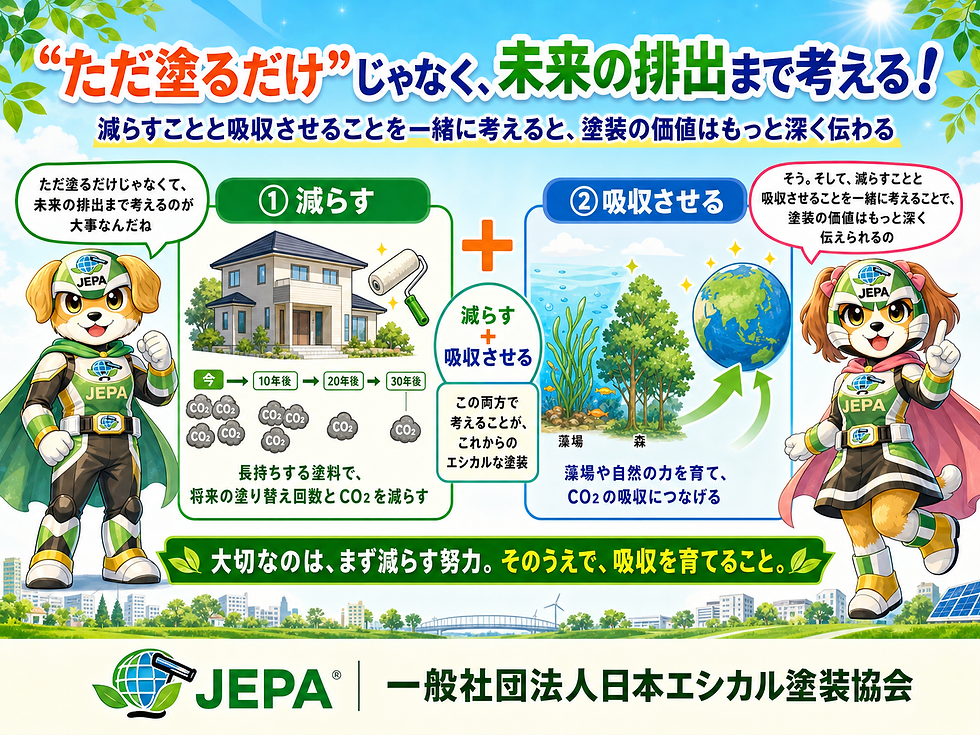
つまり、塗装で減らす。藻場で吸収を後押しする。
これが、私たちが考える外壁塗装の“二刀流”です。
藻場はブルーカーボン生態系のひとつとして注目されています。日本でも、海草藻場・海藻藻場を含む沿岸域の海洋植物によるCO₂吸収量が国連に報告されるなど、藻場の役割は社会的にも重要になっています。
まず、塗装でできることは「将来の排出を減らす」こと
塗装は、ただその場で色をつける工事ではありません。
どんな塗料を選ぶかによって、建物の保護年数や、次の塗り替えまでの期間が変わります。
LCA理論で考えると、塗料の比較は1回の工事金額だけではなく、原料調達、原料輸送、製造という製品段階の負荷と、将来何回塗り替えることになるのかまで見ていくことが大切です。
EN 15804系の考え方では、LCAの段階は次のように整理されています。
区分 | 内容 |
A1〜A3 | 製品段階。原料調達、原料輸送、製造 |
A4〜A5 | 施工段階。現場搬送、施工 |
B | 使用段階。維持管理、補修、更新など |
C1〜C4 | 廃棄段階。解体、輸送、処理、廃棄 |
D | リサイクル・再利用等による外部効果 |
本記事では、まず塗料そのものができるまでの A1〜A3 を中心に見ています。
【参考1:LCAの考え方】【参考2:EN 15804のLCA区分】

約160㎡住宅1現場あたりのA1〜A3 CO₂排出量
この参照値に、1現場あたりの使用量45kgを掛けると、約160㎡住宅1現場のA1〜A3 CO₂排出量は次のようになります。
塗料 | 1kgあたり参照値 | 1現場あたり使用量 | 1現場あたりA1〜A3 |
水性1液無機系 | 1.45 kg-CO₂e/kg | 45kg | 約65.3 kg-CO₂e |
2液水性無機系 | 2.61 kg-CO₂e/kg | 45kg | 約117.5 kg-CO₂e |
2液弱溶剤シリコン | 1.95 kg-CO₂e/kg | 45kg | 約87.8 kg-CO₂e |
この数字は、まず「今この1回でどれだけ出るか」を見せてくれます。
この時点では、1回の塗装で最もCO₂が少ないのは水性1液無機系、最も多いのは2液水性無機系という整理になります。EN 15804 Modules Explained - Circular Ecology
ただし、本当に大切なのは、この1回の数字だけではありません。
本当に大切なのは“次の塗り替えまで何年あるか”です
ここで大切なのは、1回の排出量だけを見て終わらないことです。
もし、10年で塗り替える塗料と、18年、23年と長く持つ塗料があるなら、長い目で見たときの塗り替え回数は変わってきます。
LCAの考え方では、こうした更新回数の違いが、全体の環境負荷に大きく影響します。
このシリーズの比較条件では、塗り替え周期を次のように置いています。
塗料 | 想定する塗り替え周期 | 備考 |
2液弱溶剤シリコン | 10年 | 比較用の想定条件 |
水性1液無機系 | 18年 | 比較用の想定条件 |
2液水性無機系 | 23年 | 比較用の想定条件 |
※この年数は、比較シリーズのための想定条件です。※EPDやLCA資料が、この耐用年数を保証しているわけではありません。※実際の塗り替え周期は、立地、下地、施工品質、膜厚、紫外線、雨、塩害、湿気、メンテナンス状況などで変わります。第4節 今後の海洋環境の変化への対策:水産庁
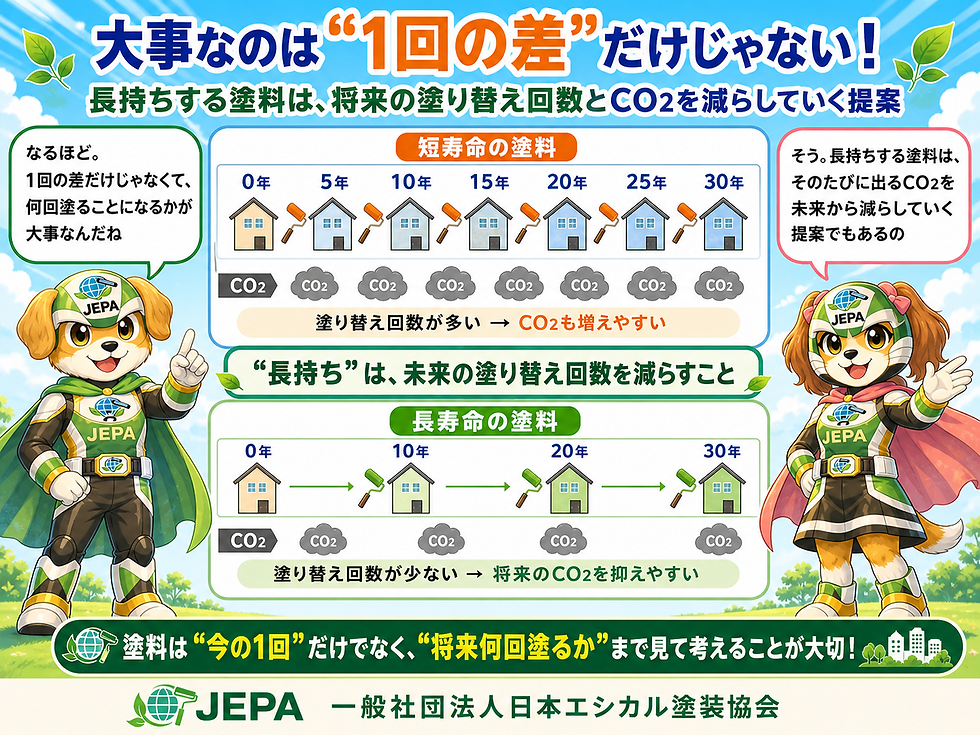
1年あたりの平均CO₂で見ると、見え方が変わる
1回あたりのCO₂を、想定する塗り替え周期で割ると、年平均CO₂は次のようになります。
塗料 | 1回あたりA1〜A3 | 想定周期 | 年平均CO₂ |
水性1液無機系 | 約65.3 kg-CO₂e | 18年 | 約3.63 kg-CO₂e/年 |
2液水性無機系 | 約117.5 kg-CO₂e | 23年 | 約5.11 kg-CO₂e/年 |
2液弱溶剤シリコン | 約87.8 kg-CO₂e | 10年 | 約8.78 kg-CO₂e/年 |
1回あたりでは2液水性無機系のCO₂排出量が大きく見えます。
しかし、塗り替え周期まで含めて年平均で見ると、10年周期の2液弱溶剤シリコンより、23年周期の2液水性無機系の方が低くなります。
つまり、塗装で減らす というのは、今の1回だけではなく、将来何度も出る排出を減らすという意味です。
50年で見ると、塗り替え回数の差がさらに見えてくる
50年という長い期間で見ると、塗り替え回数の差はよりわかりやすくなります。
塗料 | 想定周期 | 50年内の塗装時期 | 50年内の塗装回数 |
水性1液無機系 | 18年 | 0年、18年、36年 | 3回 |
2液水性無機系 | 23年 | 0年、23年、46年 | 3回 |
2液弱溶剤シリコン | 10年 | 0年、10年、20年、30年、40年 | 5回 |
この前提で、A1〜A3を積み上げると、50年累計は次のようになります。
塗料 | 1回あたりA1〜A3 | 50年内の塗装回数 | 50年累計CO₂ |
水性1液無機系 | 約65.3 kg-CO₂e | 3回 | 約195.8 kg-CO₂e |
2液水性無機系 | 約117.5 kg-CO₂e | 3回 | 約352.4 kg-CO₂e |
2液弱溶剤シリコン | 約87.8 kg-CO₂e | 5回 | 約438.8 kg-CO₂e |
1回だけを見れば中間に見える2液弱溶剤シリコンも、50年で見ると最も大きくなります。
これは、塗り替え回数が増えるほど、塗料製造段階のCO₂を何度も積み上げることになるからです。
次に、藻場でできることは「吸収を後押しする」こと
一方で、塗装だけですべてを語る必要はありません。
排出を減らすこととあわせて、吸収を後押しするという考え方もあります。
その代表的なひとつが、藻場です。第4節 今後の海洋環境の変化への対策:水産庁
藻場は、ブルーカーボンの観点からも注目されています。
また、藻場はCO₂の吸収・固定だけでなく、魚や貝などの生き物のすみか、産卵場、幼稚魚の育成場、餌場としても重要な役割を持っています。
藻場の役割 | 内容 |
CO₂吸収・固定 | ブルーカーボンとして注目されています。 |
生物多様性 | 魚、貝、甲殻類など多くの生き物のすみかになります。 |
水産資源 | 産卵場や幼稚魚の生育場として機能します。 |
海の環境保全 | 沿岸環境の安定や海の豊かさにつながります。 |
地域活動 | 漁業者、地域団体、企業、市民活動と連携しやすいテーマです。 |
【参考4:水産庁 藻場の保全・創造、磯焼け対策】【参考5:国土交通省 ブルーカーボン】【参考6:環境省・国土交通省 海洋植物によるCO₂吸収量の国連報告】
藻場の吸収量を比較用の代表値で見る
本記事では、比較用の代表値として、次の数値を使います。
藻場タイプ | 比較用代表値 | 1㎡あたりに換算 |
ガラモ場 | 7.1t-CO₂/ha/年 | 約0.71kg-CO₂/㎡/年 |
アラメ・カジメ場 | 24.6t-CO₂/ha/年 | 約2.46kg-CO₂/㎡/年 |
1haは10,000㎡です。
そのため、1㎡あたりに直すと次のようになります。
藻場タイプ | 計算式 |
ガラモ場 | 7.1t ÷ 10,000㎡ = 約0.71kg-CO₂/㎡/年 |
アラメ・カジメ場 | 24.6t ÷ 10,000㎡ = 約2.46kg-CO₂/㎡/年 |
ただし、藻場のCO₂吸収量は、海域、海藻の種類、面積、被度、現存量、流出や堆積の条件などによって変わります。
そのため、今回の数値は、あくまで比較用の代表値として扱います。
塗装で減らし、藻場で吸収を後押しする
約160㎡住宅1現場で出るA1〜A3 CO₂を、藻場の年間吸収量に置き換えると、次のようになります。
ガラモ場で見ると
塗料 | 1現場あたりA1〜A3 | ガラモ場の代表値 | ガラモ場換算 |
水性1液無機系 | 約65.3kg-CO₂e | 0.71kg-CO₂/㎡/年 | 約92㎡分/年 |
2液水性無機系 | 約117.5kg-CO₂e | 0.71kg-CO₂/㎡/年 | 約165㎡分/年 |
2液弱溶剤シリコン | 約87.8kg-CO₂e | 0.71kg-CO₂/㎡/年 | 約124㎡分/年 |
アラメ・カジメ場で見ると
塗料 | 1現場あたりA1〜A3 | アラメ・カジメ場の代表値 | アラメ・カジメ場換算 |
水性1液無機系 | 約65.3kg-CO₂e | 2.46kg-CO₂/㎡/年 | 約27㎡分/年 |
2液水性無機系 | 約117.5kg-CO₂e | 2.46kg-CO₂/㎡/年 | 約48㎡分/年 |
2液弱溶剤シリコン | 約87.8kg-CO₂e | 2.46kg-CO₂/㎡/年 | 約36㎡分/年 |
たとえば、水性1液無機系の場合、約160㎡住宅1現場で出るA1〜A3 CO₂は、ガラモ場なら約92㎡分、アラメ・カジメ場なら約27㎡分の年間吸収量に相当します。
同じCO₂量でも、どの藻場を基準にするかで必要面積は大きく変わります。
ここで大事なのは、藻場で吸収させることだけを主役にしないことです。
まずは、長持ちする塗料を選んで、将来何度も発生する排出を減らす。
そのうえで、藻場再生などの取り組みを通じて、吸収を後押ししていく。
この順番が大切です。H31houkokusho-23.pdf
100現場・1000現場に広げると、二刀流の意味が見えやすくなる
1現場では小さく見える差でも、100現場、1000現場に広がると、CO₂排出量の差は大きくなります。
1回の塗装で見た件数別CO₂
件数 | 水性1液無機系 | 2液水性無機系 | 2液弱溶剤シリコン |
1現場 | 約65.3kg-CO₂e | 約117.5kg-CO₂e | 約87.8kg-CO₂e |
100現場 | 約6.53t-CO₂e | 約11.75t-CO₂e | 約8.78t-CO₂e |
1000現場 | 約65.25t-CO₂e | 約117.45t-CO₂e | 約87.75t-CO₂e |
ガラモ場で見た場合
件数 | 水性1液無機系 | 2液水性無機系 | 2液弱溶剤シリコン |
1現場 | 約92㎡分/年 | 約165㎡分/年 | 約124㎡分/年 |
100現場 | 約0.92ha分/年 | 約1.65ha分/年 | 約1.24ha分/年 |
1000現場 | 約9.19ha分/年 | 約16.54ha分/年 | 約12.36ha分/年 |
アラメ・カジメ場で見た場合
件数 | 水性1液無機系 | 2液水性無機系 | 2液弱溶剤シリコン |
1現場 | 約27㎡分/年 | 約48㎡分/年 | 約36㎡分/年 |
100現場 | 約0.27ha分/年 | 約0.48ha分/年 | 約0.36ha分/年 |
1000現場 | 約2.65ha分/年 | 約4.77ha分/年 | 約3.57ha分/年 |
件数が増えるほど、塗料選びによるCO₂排出量の差は、海の面積としても見えやすくなります。
に、藻場でできることは「吸収を後押しする」こと
一方で、塗装だけですべてを語る必要はありません。排出を減らすこととあわせて、吸収を後押しするという考え方もあります。
その代表的なひとつが、藻場です。水産庁は、藻場や干潟などの保全・創出が、ブルーカーボンの観点からも期待されると説明しています。
比較用の代表値として、水産庁資料では
ガラモ場:7.1t-CO2/ha/年
アラメ場:24.6t-CO2/ha/年
が示されています。記事では、あなたのテーマに合わせて、アラメ・カジメ場として扱うのが自然です。第4節 今後の海洋環境の変化への対策:水産庁
これを1㎡あたりに直すと、
ガラモ場:約0.71kg-CO2/㎡・年
アラメ・カジメ場:約2.46kg-CO2/㎡・年
つまり、塗装で減らし、藻場で吸収させる、という考え方ができる
たとえば、160㎡住宅1現場で出る約96.7kg-CO2eを、藻場で考えると、
ガラモ場なら 約136㎡分/年
アラメ・カジメ場なら 約39㎡分/年
の年間吸収量に相当します。同じように、約130.0kgならガラモ場で約183㎡分、アラメ・カジメ場で約53㎡分、約174.0kgならガラモ場で約245㎡分、アラメ・カジメ場で約71㎡分です。H31houkokusho-23.pdf
ここで大事なのは、藻場で吸収させることだけを主役にしないことです。
まずは、長持ちする塗料を選んで、将来何度も発生する排出を減らす。そのうえで、藻場再生などの取り組みを通じて、吸収を後押ししていく。
この順番が大切です。

このページで見てほしい視点を、もう一度まとめます
このページで見ていただきたいのは、次の順番です。
順番 | 見る内容 |
1 | 1回の塗装でどれくらいCO₂が出るか |
2 | 塗り替え周期によって、将来の排出量がどう変わるか |
3 | 長持ちする塗料を選ぶことで、将来の塗り替え回数を減らせるか |
4 | 藻場再生などを通じて、吸収を後押しできるか |
5 | 塗装で減らすことと、藻場で育てることを同時に進められるか |
つまり、
二刀流 | 意味 |
塗装で減らす | 長持ちする塗料で、将来の排出を減らす |
藻場で吸収を後押しする | 藻場再生などを通じて、海の吸収力を育てる |
この2つを分けて考えるのではなく、同時に進める発想が大切です。
これが、私たちが考える これからの外壁塗装の“二刀流” です。
まとめ
外壁塗装の環境配慮は、「環境にいい塗料を使う」という一言では終わりません。
本当に大切なのは、次の3つです。
大切なこと | 内容 |
長持ちする塗料を選ぶこと | 将来の塗り替え回数を減らす |
将来のCO₂排出を減らすこと | 何度も発生する塗料製造・施工・廃棄の負荷を抑える |
藻場再生などを応援すること | 海の吸収力や生態系の回復を後押しする |
つまり、塗装で減らす。藻場で吸収を後押しする。
この二刀流で考えることで、塗装の提案は、単なる工事の提案ではなく、未来の環境負荷まで見据えた提案に変わっていきます。
これからは、塗装の在り方や価値そのものが変化していく時代です。
私たちは、外壁塗装を通じて、建物を守るだけでなく、環境負荷の低減と自然環境の再生に貢献する道を考えていきたいと思います。
注意書き
項目 | 注意内容 |
数値の性質 | 本記事の塗料CO₂数値は、約160㎡住宅、上塗り2回、15kg缶で約115㎡塗布、3缶=45kg基準による簡易比較値です。 |
認証値ではない | 製品個別の第三者認証値やEPD値そのものではありません。 |
比較範囲 | 今回の塗料比較範囲は主にA1〜A3です。 |
含まれていない範囲 | A4〜A5、B段階、C1〜C4、足場、現場搬送、施工燃料、余剰塗料、廃棄などは含んでいません。 |
塗り替え周期 | 10年、18年、23年は、この比較シリーズのための想定条件です。 |
耐用年数 | EPDやLCA資料が、この耐用年数を保証しているわけではありません。 |
藻場換算 | 藻場の吸収量は、海域、海藻種、被度、面積、現存量、流出・堆積条件などによって変動します。 |
固定と貯留 | 光合成で固定される量と、長期的に貯留される量は同じではありません。 |
本記事での扱い | 本記事では、比較用の代表値としてガラモ場とアラメ・カジメ場を基準にしています。 |
※藻場の吸収量は、海域、海藻種、面積、被度などによって変動します。本記事では、水産庁資料に示された比較用の代表値を使用しています。 H31houkokusho-23.pdf
※LCA区分の A1〜A3、A4〜A5、B、C、D は EN 15804 系の一般的な建材LCA区分に基づいています。EN 15804 Modules Explained - Circular Ecology
参考文献・確認資料
参考番号 | 資料名 | 本文中で使う場所 | URL |
参考1 | ISO 14040 Life Cycle Assessment | LCAの考え方 | |
参考2 | EN 15804 Modules Explained | A1〜A3、A4〜A5、B段階、C段階の説明 | |
参考3 | The International EPD System / Environmental Product Declaration | EPD・環境製品宣言の説明 | |
参考4 | 水産庁「藻場の保全・創造、磯焼け対策」 | 藻場とブルーカーボンの説明 | |
参考5 | 国土交通省 港湾局「ブルーカーボン」 | ブルーカーボンの定義 | |
参考6 | 国土交通省「我が国の沿岸域に生息する海洋植物による二酸化炭素の吸収量が国連に報告されました」 | 約35万トンの国連報告 |
確認日:2026年6月10日
#外壁塗装 #LCA理論 #LCA塗装 #CO2排出量 #塗料CO2比較 #塗装の環境負荷 #A1A3 #EPD #環境製品宣言 #ブルーカーボン #藻場再生 #藻場育成 #ガラモ場 #アラメカジメ場 #塗装で減らす #藻場で吸収 #二刀流 #エシカル塗装 #日本エシカル塗装協会 #JEPA #水性1液無機系 #2液弱溶剤シリコン #上塗り2回 #塗り替え周期 #長持ちする塗料 #CO2削減 #環境にやさしい塗装 #CSR #ESG #持続可能な住まい #建物を長く守る #海の環境保全

Reduce Through Painting, Absorb Through Seaweed Beds
The Future of Exterior Wall Painting Should Be Considered as a “Two-Way Approach”
When people talk about environmentally conscious exterior wall painting, the conversation often ends with simply “using environmentally friendly paint.”
Of course, that is important.
However, what truly matters is not only that.
We believe that the future of exterior wall painting should be considered from two perspectives.
First, choosing long-lasting paint to reduce future emissions.
Second, supporting CO₂ absorption through initiatives such as seaweed bed regeneration.
In other words:
Reduce through painting. Absorb through seaweed beds.
This is the “two-way approach.”
Seaweed beds are included in blue carbon ecosystems, and the total CO₂ absorption by seaweed beds in Japan’s coastal areas has been reported to the United Nations as approximately 350,000 tons.
First, What Painting Can Do Is Reduce Future Emissions
Painting is not simply a construction work that adds color to a building.
The type of paint selected can change how long the building is protected and how long it will be until the next repainting.
From the perspective of LCA theory, paint should not be compared only by the cost of one project.
It is important to consider both the product-stage impact of raw material supply, transport, and manufacturing, and how many times repainting will be required in the future.
In the EN 15804 framework, A1–A3 are classified as the product stage, A4–A5 as the construction stage, B as the use stage, and C as the end-of-life stage.
Long-Lasting Painting Reduces Both Economic Burden and Environmental Impact
Looking at One 160㎡ Residential Project, the CO₂ Emitted “Now” Looks Like This
In this series, we use a 160㎡ residential exterior wall as the model and compare all paints under the unified condition of:
15kg of paint covers 36㎡
Under this condition, the amount of paint used for one project is:
66.67kg
Based on reference values from publicly available EPDs, the A1–A3 values per kg can be set as follows:
Water-based one-component inorganic coating: 1.45 kg-CO₂e/kg
Water-based two-component inorganic coating: 2.61 kg-CO₂e/kg
Two-component weak-solvent silicone coating: 1.95 kg-CO₂e/kg
Applying these values to the 160㎡ model, the A1–A3 emissions per project are:
Water-based one-component inorganic coating: approx. 96.7 kg-CO₂e
Water-based two-component inorganic coating: approx. 174.0 kg-CO₂e
Two-component weak-solvent silicone coating: approx. 130.0 kg-CO₂e
These numbers show how much CO₂ is emitted from this one application.
But What Truly Matters Is How Many Years Until the Next Repainting
The important point is not to stop at the emissions from one application.
If one paint requires repainting after 10 years, while another lasts 18 or 23 years, the number of repainting cycles over the long term will change.
From the perspective of LCA, differences in renewal cycles can have a major impact on the overall environmental burden.
In this series, the assumed repainting cycles are:
Two-component weak-solvent silicone coating: 10 years
Water-based one-component inorganic coating: 18 years
Water-based two-component inorganic coating: 23 years
When converted into annual averages under these conditions:
Water-based one-component inorganic coating: approx. 5.37 kg-CO₂e/year
Water-based two-component inorganic coating: approx. 7.57 kg-CO₂e/year
Two-component weak-solvent silicone coating: approx. 13.00 kg-CO₂e/year
In other words, “reducing through painting” does not only mean reducing emissions from the current project.
It also means reducing emissions that would occur repeatedly in the future.
Ethical Painting® Helps Suppress CO₂ Emissions
What Seaweed Beds Can Do Is Support CO₂ Absorption
On the other hand, we do not need to discuss everything only through painting.
Along with reducing emissions, there is also the idea of supporting absorption.
One representative example is seaweed beds.
Japan’s Fisheries Agency explains that the conservation and creation of seaweed beds and tidal flats are expected to contribute from the perspective of blue carbon.
As representative values for comparison, Fisheries Agency materials show:
Sargassum beds: 7.1 t-CO₂/ha/year
Eisenia beds: 24.6 t-CO₂/ha/year
For this article, in line with the theme, it is natural to describe this as Eisenia/Kajime seaweed beds.
Converted into absorption per square meter, these values are:
Sargassum beds: approx. 0.71 kg-CO₂/㎡/year
Eisenia/Kajime seaweed beds: approx. 2.46 kg-CO₂/㎡/year
Reduce Through Painting and Absorb Through Seaweed Beds
For example, if we look at the approximately 96.7 kg-CO₂e emitted from one 160㎡ residential painting project in terms of seaweed beds, it is equivalent to the annual absorption of:
Approx. 136㎡ of Sargassum beds
Approx. 39㎡ of Eisenia/Kajime seaweed beds
Similarly:
For approx. 130.0 kg-CO₂e:
Approx. 183㎡ of Sargassum beds
Approx. 53㎡ of Eisenia/Kajime seaweed beds
For approx. 174.0 kg-CO₂e:
Approx. 245㎡ of Sargassum beds
Approx. 71㎡ of Eisenia/Kajime seaweed beds
However, the important point is not to make seaweed bed absorption the only main focus.
First, we should choose long-lasting paints to reduce emissions that would otherwise occur repeatedly in the future.
Then, on top of that, we can support absorption through initiatives such as seaweed bed regeneration.
This order is important.
Reducing Through Painting and Reducing Through Absorption
This Two-Way Approach Will Also Change How We Communicate the Value of Painting
Until now, painting proposals have often focused on price, appearance, specifications, and weather resistance.
Of course, these are still important.
However, from now on, we can add another perspective:
Can this proposal reduce future emissions?
Can it also contribute to creating absorption sources for society?
Choosing long-lasting paint is not simply about “better durability.”
It is also a proposal to reduce future emissions.
Furthermore, supporting seaweed bed regeneration can lead to actions that help grow the ocean’s absorption capacity.
Let’s Summarize the Viewpoint of This Page Once More
What we want you to see on this page is the following order.
First, whether choosing a long-lasting paint can reduce future emissions.
Next, whether, on top of that, we can support absorption through initiatives such as seaweed bed regeneration.
In other words:
Reduce through painting
Absorb through seaweed beds
Rather than thinking of these two separately, it is important to move both forward at the same time.
This is what we believe to be the future “two-way approach” to exterior wall painting.
Summary
Environmental consideration in exterior wall painting does not end with the phrase, “Use environmentally friendly paint.”
What truly matters is:
Choosing long-lasting paint and reducing the number of future repainting cycles
Reducing future CO₂ emissions as a result
Supporting the ocean’s absorption capacity through initiatives such as seaweed bed regeneration
In other words:
Reduce through painting. Absorb through seaweed beds.
By thinking with this two-way approach, painting proposals can evolve from simple construction proposals into proposals that look ahead to future environmental impact.
We hope the future will be an era in which the meaning and value of painting continue to change.
Notes
The paint-related CO₂ values in this article are simple comparison values based on unified conditions of 160㎡ and 36㎡ coverage per 15kg, using publicly available EPDs as references.
They are not certified values for individual products.
The CO₂ absorption capacity of seaweed beds varies depending on sea area, seaweed species, area, coverage, and other conditions.
This article uses representative values shown in materials from Japan’s Fisheries Agency for comparison.
The LCA classifications A1–A3, A4–A5, B, C, and D are based on the general building material LCA categories used in the EN 15804 framework.
#EnvironmentalImpactOfPaint #ExteriorWallPainting #CO2Emissions #LifeCycleAssessment #LCATheory #A1A3 #EPD #BlueCarbon #SeaweedBeds #MarineCarbonAbsorption #SeaweedBedRegeneration #OceanConservation #CO2Reduction #ReduceThroughPainting #AbsorbThroughSeaweedBeds #TwoWayApproach #SustainablePainting #LongLastingPaint #RepaintingCycle #EthicalPainting #JapanEthicalPaintingAssociation #JEPA


コメント