
外壁塗装1現場のCO2は、杉の木何本分なのか?
- ボディデザイン アウラン
- 5月7日
- 読了時間: 14分

約160㎡住宅1現場で見る、塗料ごとの環境負荷
外壁塗装の環境負荷を考えるとき、「CO₂が何kg出る」と言われても、少しイメージしにくいことがあります。
そこで今回は、約160㎡の住宅1現場で出るCO₂を、杉の木が1年間に吸収する量に置き換えて見ていきます。
ただし、ここで大切なのは、“杉の木何本分か”という数字そのものがゴールではないということです。
このページで見ていただきたいのは、次の2つです。
見てほしい視点 | 内容 |
1回の塗装で出るCO₂ | 約160㎡住宅1現場で、塗料製造段階までにどれくらいCO₂が出るのか |
将来の排出を減らせるか | 長持ちする塗料を選ぶことで、将来の塗り替え回数を減らし、そのぶん将来の排出も抑えやすくなるのか |
つまり、杉の木何本分という表現は、CO₂を身近に感じるための入口です。
そして本当に考えたいのは、これから先の排出をどう減らせるかです。
まず、今回の比較条件です
今回の比較では、前回までに整理した条件に合わせて、約160㎡住宅の外壁を上塗り2回で仕上げる場合をモデルにします。
項目 | 条件・計算 |
住宅外壁面積 | 約160㎡ |
上塗り回数 | 2回 |
上塗りの延べ塗布面積 | 160㎡ × 2回 = 320㎡ |
塗料1缶 | 15kg |
1缶あたりの塗布可能面積 | 約115㎡ |
必要缶数 | 320㎡ ÷ 115㎡ = 約2.78缶 |
計算上の使用量 | 約2.78缶 × 15kg = 約41.7kg |
実務上の手配量 | 3缶 = 45kg |
本記事での比較基準 | 45kg基準 |
つまり、160㎡の住宅に上塗りを2回行う場合、実際に塗る面積は160㎡ではなく、延べ320㎡になります。
1缶15kgで約115㎡塗れるとすると、必要缶数は約2.78缶です。
ただし、実際の現場では2.78缶だけを用意するのではなく、基本的には3缶を手配することになります。
そのため、本記事では、実務上わかりやすく 3缶=45kg を、約160㎡住宅1現場あたりの上塗り使用量として比較します。
今回比較している範囲はA1〜A3です
今回比較しているのは、LCAでいうA1〜A3です。
区分 | 内容 |
A1 | 原料調達 |
A2 | 原料輸送 |
A3 | 製造 |
つまり今回は、塗装工事全体のすべてを比較するものではありません。
足場、現場への配送、施工時の燃料、養生材、廃棄、将来の塗り替え回数などは、このA1〜A3の比較には含めていません。
まずは、塗料そのものができるまでのCO₂排出量を中心に見ています。
【参考1:LCAの考え方】【参考2:A1〜A3の考え方】【参考3:EPD・環境製品宣言の考え方】
今回の塗料比較に使う参照値
今回の比較は、製品個別の認証値そのものではなく、外壁塗装における環境負荷をわかりやすく見るための簡易比較です。
今回の参照値は、次のように置いています。
塗料 | 1kgあたり参照値 | 補足 |
水性1液無機系 | 1.45 kg-CO₂e/kg | 水性塗料系の比較用参照値 |
2液水性無機系 | 2.61 kg-CO₂e/kg | 水性2液高機能系の比較用参照値 |
2液弱溶剤シリコン | 1.95 kg-CO₂e/kg | 溶剤系コーティングの比較用参照値 |
※本記事の数値は、製品個別の第三者認証値やEPD値そのものではありません。※塗料の設計、原材料、製造条件、容器、算定範囲によって実際の数値は変わります。
約160㎡住宅1現場あたりのA1〜A3 CO₂排出量
この参照値に、1現場あたりの使用量45kgを掛けると、約160㎡住宅1現場のA1〜A3 CO₂排出量は次のようになります。
塗料 | 1kgあたり参照値 | 1現場あたり使用量 | 1現場あたりA1〜A3 |
水性1液無機系 | 1.45 kg-CO₂e/kg | 45kg | 約65.3 kg-CO₂e |
2液水性無機系 | 2.61 kg-CO₂e/kg | 45kg | 約117.5 kg-CO₂e |
2液弱溶剤シリコン | 1.95 kg-CO₂e/kg | 45kg | 約87.8 kg-CO₂e |
今回の条件では、1回の塗装で最もCO₂が少ないのは水性1液無機系、最も多いのは2液水性無機系という整理になります。
ただし、これはあくまでA1〜A3の範囲です。
本来のLCAでは、施工段階、使用段階、廃棄段階、将来の塗り替え回数まで含めて考える必要があります。

でも、本当に見てほしいのは“7.4本分”で終わる話ではありません
ここで見てほしいのは、単に「水性1液無機系は約7.4本分です」という数字だけではありません。
大切なのは、次の3つです。
大切な視点 | 内容 |
1回の塗装でCO₂が出る | 塗料を製造する段階でもCO₂が発生します。 |
塗料によって差がある | 同じ約160㎡住宅でも、塗料の種類によってA1〜A3排出量に差が出ます。 |
塗り替え回数が重要 | 長持ちする塗料なら、将来の塗り替え回数を減らせる可能性があります。 |
今回の「杉の木約7.4本分」「約10本分」「約13.3本分」という表現は、今この1回で出る排出量を、わかりやすく見える形にしたものです。
そして、その先に本当に大切なのは、将来何回塗り替えることになるのかです。
もし塗り替え回数を減らせれば、次の塗装、その次の塗装で出るCO₂も減らせます。
ここが、LCA理論で考えるときの大事な着地点です。
杉の木は何歳でも同じではありません
ここで、ひとつ注意もあります。
杉の木は、10年生、30年生、40年生で、同じ量を吸収するわけではありません。
森林のCO₂吸収量は、樹種だけでなく、林齢、本数、樹高、直径、森林の管理状態などによって変わります。
今回使っている 8.8kg-CO₂/本・年 は、あくまで 36〜40年生のスギ人工林を比較用にわかりやすくした目安 です。
注意点 | 内容 |
樹齢で変わる | 若い木と成熟した木では吸収量が異なります。 |
本数密度で変わる | 1ヘクタールあたりの本数によって、1本あたり換算は変わります。 |
地域条件で変わる | 気候、土壌、管理状況によって変わります。 |
今回の使い方 | 36〜40年生のスギ1本を比較用の基準木として使っています。 |
ですので、今回の「何本分」という表現は、
比較用の基準木として、36〜40年生のスギ1本を使った場合の目安
として読んでいただくのが正確です。
件数が増えると、差はもっとわかりやすくなります
1現場だけだと、7.4本、10本、13.3本という差は、まだ小さく感じるかもしれません。
でも、これが100現場、1000現場になると見え方は大きく変わります。
件数 | 水性1液無機系 | 2液水性無機系 | 2液弱溶剤シリコン |
1現場 | 約65.3 kg-CO₂e | 約117.5 kg-CO₂e | 約87.8 kg-CO₂e |
100現場 | 約6.53 t-CO₂e | 約11.75 t-CO₂e | 約8.78 t-CO₂e |
1000現場 | 約65.25 t-CO₂e | 約117.45 t-CO₂e | 約87.75 t-CO₂e |
これを同じく、スギ1本=年間8.8kg-CO₂吸収で換算すると、次のようになります。
件数 | 水性1液無機系 | 2液水性無機系 | 2液弱溶剤シリコン |
1現場 | 約7.4本分 | 約13.3本分 | 約10.0本分 |
100現場 | 約742本分 | 約1,335本分 | 約997本分 |
1000現場 | 約7,415本分 | 約13,347本分 | 約9,972本分 |
つまり、1件ごとの差は、件数が増えるほど、はっきり積み上がっていくということです。
CO₂削減は、1件だけでは小さく見えても、積み重なることで大きな差になります。
塗り替え回数で見ると、さらに重要性が見えてきます
杉の木換算は、1回の塗装によるCO₂排出量をイメージするための方法です。
しかし、外壁塗装で本当に重要なのは、1回の排出量だけではありません。
たとえば、塗り替え周期が短い塗料は、50年の間に何度も塗り替えることになります。
一方で、長持ちする塗料は、同じ50年でも塗り替え回数を減らせる可能性があります。
視点 | 短い周期で塗り替える場合 | 長い周期で塗り替える場合 |
塗装回数 | 増えやすい | 減らしやすい |
塗料製造のCO₂ | 繰り返し発生する | 発生回数を抑えやすい |
足場・施工・廃棄 | 回数分増えやすい | 回数を減らせる可能性がある |
長期的な環境負荷 | 大きくなりやすい | 抑えやすい |
つまり、杉の木何本分という表現は、CO₂を身近にする入口です。
その先にある本当のテーマは、塗り替え回数を減らすことで、将来のCO₂排出をどれだけ抑えられるか です。

このページで見てほしい視点を、もう一度まとめます
このページで見ていただきたいのは、次の順番です。
順番 | 見る内容 |
1 | 1回の塗装でどれだけCO₂が出るか |
2 | それが杉の木何本分の年間吸収量に相当するか |
3 | 塗料によってCO₂排出量に差があること |
4 | 長持ちする塗料を選ぶことで、将来の塗り替え回数を減らせる可能性があること |
5 | 塗り替え回数を減らすことが、将来のCO₂排出削減につながること |
この流れで見ていただくと、「何本分か」という数字が、単なる豆知識ではなく、これから先の塗装提案の考え方につながっていきます。
まとめ
約160㎡住宅1現場のA1〜A3 CO₂排出量を、36〜40年生のスギ1本=年間8.8kg-CO₂吸収という林野庁の目安で置き換えると、次のようになります。
塗料 | 1現場あたりA1〜A3 | 杉の木換算 |
水性1液無機系 | 約65.3 kg-CO₂e | 約7.4本分 |
2液水性無機系 | 約117.5 kg-CO₂e | 約13.3本分 |
2液弱溶剤シリコン | 約87.8 kg-CO₂e | 約10.0本分 |
ただし、本当に大切なのは、今この1回で何本分かだけではありません。
大切なのは、長持ちする塗料を選ぶことで、将来の塗り替え回数を減らし、そのたびに発生するCO₂を抑えていけるかどうかです。
つまり、杉の木何本分かは、考え始めるための入口です。
着地点は、将来の排出を減らせる塗装提案かどうか にあります。
次回は、杉の木ではなく、藻場で見るとどれくらいになるのか、ガラモ場やアラメ・カジメ場ではどう違うのかを整理していきます。
注意書き
項目 | 注意内容 |
数値の性質 | 本記事の数値は、約160㎡住宅、上塗り2回、15kg缶で約115㎡塗布、3缶=45kg基準による簡易比較値です。 |
認証値ではない | 製品個別の第三者認証値やEPD値そのものではありません。 |
比較範囲 | 今回の比較範囲は主にA1〜A3です。 |
含まれていない範囲 | A4〜A5、B段階、C1〜C4、足場、現場搬送、施工燃料、余剰塗料、廃棄などは含んでいません。 |
杉換算 | スギ1本あたり年間8.8kg-CO₂吸収は、林野庁が公開している36〜40年生スギ人工林の目安を使用しています。 |
杉の吸収量 | 樹齢、本数密度、地域条件、森林管理の状態によって変動します。 |
参考文献・確認資料
参考番号 | 資料名 | 本文中で使う場所 | URL |
参考1 | ISO 14040 Life Cycle Assessment | LCAの考え方 | |
参考2 | EN 15804 Modules Explained | A1〜A3、A4〜A5、B段階、C段階の説明 | |
参考3 | The International EPD System / Environmental Product Declaration | EPD・環境製品宣言の説明 | |
参考4 | 林野庁「森林はどのぐらいの量の二酸化炭素を吸収しているの?」 | 杉1本あたり年間8.8kg-CO₂吸収の根拠 |
確認日:2026年6月10日
#外壁塗装 #CO2排出量 #杉の木換算 #LCA理論 #LCA塗装 #簡易LCA比較 #A1A3 #EPD #環境製品宣言 #塗料CO2比較 #塗装の環境負荷 #水性1液無機系 #2液水性無機系 #2液弱溶剤シリコン #160㎡住宅 #上塗り2回 #塗料使用量 #塗り替え周期 #長持ちする塗料 #CO2削減 #環境にやさしい塗装 #エシカル塗装 #日本エシカル塗装協会 #CSR #ESG #持続可能な住まい #建物を長く守る
※本記事の比較範囲は主に A1〜A3 です。施工、使用、廃棄までをすべて含むフルLCAではありません。
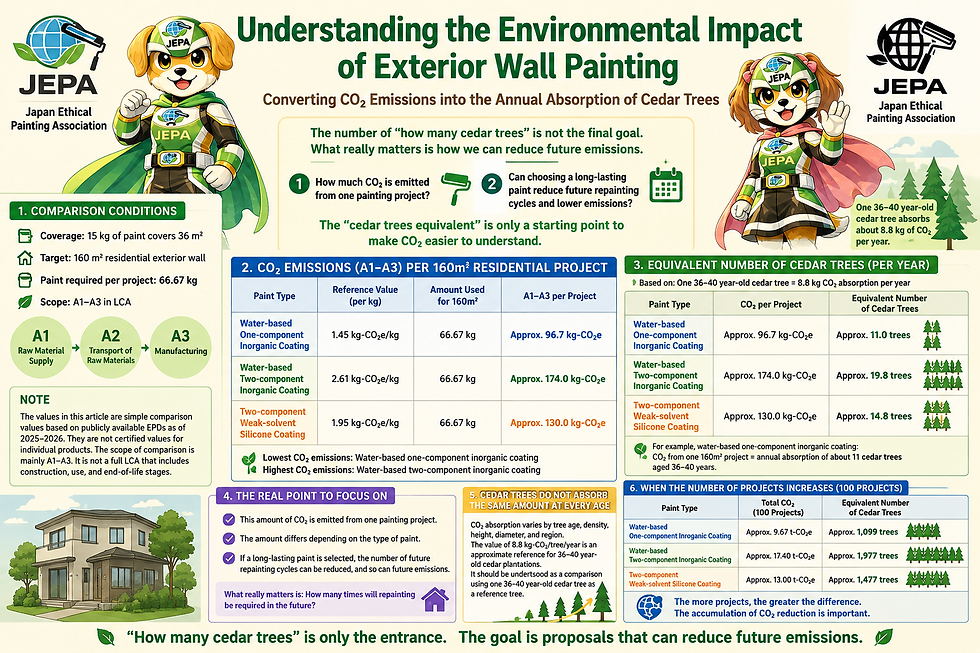
Understanding the Environmental Impact of Exterior Wall Painting
Converting CO₂ Emissions into the Annual Absorption of Cedar Trees
When thinking about the environmental impact of exterior wall painting, it can be difficult to picture what it means when someone says, “This produces ○ kg of CO₂.”
So, in this article, we will look at the CO₂ emitted from one 160㎡ residential painting project by converting it into the annual CO₂ absorption equivalent of cedar trees.
However, the important point is this:
The number of “how many cedar trees” is not the final goal.
What we want you to see on this page are two things.
First, how much CO₂ is emitted from one painting project.
Second, whether choosing a long-lasting paint can reduce the number of repainting cycles in the future, and therefore help reduce future emissions.
In other words, expressing CO₂ as “the equivalent of ○ cedar trees” is only an entrance point to make CO₂ easier to understand.
What we really want to think about is how to reduce emissions in the future.
First, the Comparison Conditions
In this comparison, all three types of paint are compared under the same condition:
15kg of paint covers 36㎡
This makes it easier to avoid differences caused by application conditions.
The target of comparison is a 160㎡ residential exterior wall.
Under this condition, the amount of paint required for one project is:
66.67kg
This comparison mainly focuses on A1–A3 in LCA.
A1–A3 means:
A1: Raw material supply
A2: Transport of raw materials
A3: Manufacturing
In other words, this article mainly looks at the CO₂ emissions generated up to the point where the paint is manufactured.
Visualizing CO₂ Emissions from Paint Manufacturing
The Latest Reference Values Used in This Paint Comparison
This comparison is not based on certified values for individual products.
It is a simple comparison based on publicly available EPDs that can currently be confirmed.
The reference values used in this comparison are as follows:
Water-based one-component inorganic coating
1.45 kg-CO₂e/kg
This is a reference value for comparison, based on the range of recently published EPD values for water-based paints.
Water-based two-component inorganic coating
2.61 kg-CO₂e/kg
This refers to the latest publicly available EPD for water-based two-component high-performance coatings.
Two-component weak-solvent silicone coating
1.95 kg-CO₂e/kg
This refers to the latest publicly available EPD for solvent-based coatings.
When these reference values are multiplied by the amount used per project, 66.67kg, the A1–A3 emissions for one 160㎡ residential project are as follows:
Paint Type | Reference Value per kg | Amount Used for 160㎡ | A1–A3 per Project |
Water-based one-component inorganic coating | 1.45 kg-CO₂e/kg | 66.67kg | Approx. 96.7 kg-CO₂e |
Water-based two-component inorganic coating | 2.61 kg-CO₂e/kg | 66.67kg | Approx. 174.0 kg-CO₂e |
Two-component weak-solvent silicone coating | 1.95 kg-CO₂e/kg | 66.67kg | Approx. 130.0 kg-CO₂e |
Under these conditions, the paint with the lowest CO₂ emissions per application is the water-based one-component inorganic coating.
The paint with the highest CO₂ emissions per application is the water-based two-component inorganic coating.
How Many Cedar Trees Is That Equivalent To?
To make the numbers easier to imagine, let’s convert them into the annual CO₂ absorption of cedar trees.
According to general information currently published by Japan’s Forestry Agency, a 36- to 40-year-old cedar plantation absorbs approximately 8.8kg of CO₂ per tree per year.
This figure is based on an estimate assuming 1,000 standing trees per hectare.
Using this standard:
One 36- to 40-year-old cedar tree = 8.8kg of CO₂ absorption per year
the CO₂ emissions from one 160㎡ residential painting project can be understood as follows:
Paint Type | CO₂ per Project | Equivalent Number of Cedar Trees |
Water-based one-component inorganic coating | Approx. 96.7 kg-CO₂e | Approx. 11.0 trees |
Water-based two-component inorganic coating | Approx. 174.0 kg-CO₂e | Approx. 19.8 trees |
Two-component weak-solvent silicone coating | Approx. 130.0 kg-CO₂e | Approx. 14.8 trees |
For example, in the case of a water-based one-component inorganic coating:
The CO₂ emitted from one 160㎡ residential painting project is equivalent to the amount of CO₂ absorbed in one year by approximately 11 cedar trees aged 36 to 40 years.
Similarly, the two-component weak-solvent silicone coating is close to 15 cedar trees, and the water-based two-component inorganic coating is close to 20 cedar trees.
Changing the Example Makes It Easier to Understand
But the Real Point Is Not Just “11 Trees”
What we want you to see here is not simply the number, such as:
“Water-based one-component inorganic coating is equivalent to about 11 cedar trees.”
The important points are:
This amount of CO₂ is emitted from one painting project.
The amount differs depending on the type of paint.
If a long-lasting paint is selected, the number of future repainting cycles can be reduced.
In other words, expressions such as “about 11 cedar trees,” “about 15 cedar trees,” and “about 20 cedar trees” are simply ways to make the emissions from one application easier to visualize.
What really matters beyond that is:
How many times will repainting be required in the future?
If the number of repainting cycles can be reduced, then the CO₂ emitted from the next painting project, and the one after that, can also be reduced.
This is the important destination point when thinking from the perspective of LCA theory.
Thinking About CO₂ Reduction Through Repainting Cycles Using Cedar Trees as an Example
Cedar Trees Do Not Absorb the Same Amount at Every Age
There is also one important point to keep in mind.
A cedar tree does not absorb the same amount of CO₂ at 10 years old, 30 years old, and 40 years old.
The Forestry Agency also explains that forest CO₂ absorption is considered based not only on tree species, but also on factors such as forest age, number of trees, tree height, and trunk diameter.
The value used in this article:
8.8 kg-CO₂ per tree per year
is only an easy-to-understand reference value based on a 36- to 40-year-old cedar plantation.
Therefore, the expression “equivalent to ○ cedar trees” should be understood as:
an approximate comparison using one 36- to 40-year-old cedar tree as a reference tree.
As the Number of Projects Increases, the Difference Becomes Clearer
For just one project, the difference between 11 trees, 15 trees, and 20 trees may still feel small.
However, when this becomes 100 projects, the difference becomes much clearer.
For 100 projects, the emissions become:
Water-based one-component inorganic coating: approx. 9.67 t-CO₂e
Water-based two-component inorganic coating: approx. 17.40 t-CO₂e
Two-component weak-solvent silicone coating: approx. 13.00 t-CO₂e
Converting these again using:
One cedar tree = 8.8 kg-CO₂ absorption per year
the results are:
Water-based one-component inorganic coating: approx. 1,099 trees
Water-based two-component inorganic coating: approx. 1,977 trees
Two-component weak-solvent silicone coating: approx. 1,477 trees
In other words, differences that may seem small in one project become more clearly visible as the number of projects increases.
The Accumulation of CO₂ Reduction Is Important
Let’s Summarize the Viewpoint of This Page Once More
What we want you to see on this page is the following flow.
First, how much CO₂ is emitted from one painting project.
Next, how many cedar trees’ annual absorption that amount is equivalent to.
And finally, the most important point:
By choosing a long-lasting paint, it may be possible to reduce the number of repainting cycles in the future and make it easier to reduce future emissions.
When you look at it this way, the number of “how many trees” is not just trivia.
It becomes connected to the way we think about exterior wall painting proposals from now on.
Summary
When the A1–A3 CO₂ emissions from one 160㎡ residential painting project are converted using the Forestry Agency’s reference value of:
One 36- to 40-year-old cedar tree = 8.8 kg of CO₂ absorption per year
the results are:
Water-based one-component inorganic coating: approx. 11.0 trees
Water-based two-component inorganic coating: approx. 19.8 trees
Two-component weak-solvent silicone coating: approx. 14.8 trees
However, what is truly important is not only how many trees the emissions from one application are equivalent to.
The important point is whether choosing a long-lasting paint can reduce the number of future repainting cycles and help reduce the CO₂ emissions generated each time.
In other words:
The number of cedar trees is only the entrance point for understanding.
The real destination is whether the painting proposal can help reduce future emissions.
In the next article, instead of cedar trees, we will look at how these values appear when compared with seaweed beds, including differences between Sargassum beds and Ecklonia/Kajime seaweed beds.
Notes
The values in this article are simple comparison values based on unified conditions of 160㎡ and 36㎡ coverage per 15kg, and publicly available EPDs that could be confirmed as of 2025–2026.
They are not certified values for individual products.
The value of 8.8 kg-CO₂ absorption per cedar tree per year is based on the current reference value published by Japan’s Forestry Agency for 36- to 40-year-old cedar plantations.
This value may vary depending on tree age, tree density, and regional conditions.
The scope of comparison in this article is mainly A1–A3.
It is not a full LCA that includes construction, use, and end-of-life stages.
#EnvironmentalImpactOfPaint #ExteriorWallPainting #CO2Emissions #LifeCycleAssessment #LCATheory #SimpleLCAComparison #A1A3 #EPD #SustainablePainting #EcoFriendlyPainting #LongLastingPaint #RepaintingCycle #CO2Reduction #CedarTreeComparison #SustainableHomes #EthicalPainting #JapanEthicalPaintingAssociation #JEPA


コメント