海の森が消えていく時代に、私たちは何ができるのか
- ボディデザイン アウラン
- 6月1日
- 読了時間: 16分

カジメ藻場の調査協力から考える、温暖化・磯焼け・ブルーカーボンの現在地
一般社団法人日本エシカル塗装協会 代表理事 栗田真徳
海の森が消えていく時代に、私たちは何ができるのか
海の中には、森があります。
陸上の森が木々によってつくられるように、海の中には海藻や海草によってつくられる「藻場」があります。
藻場は、魚や貝、エビ、カニ、小さな生き物たちのすみかになります。魚の産卵場所や、稚魚が育つ場所にもなります。海の水質を整える働きもあります。そして近年では、二酸化炭素を吸収・貯留する「ブルーカーボン」の場としても注目されています。
国土交通省では、藻場や干潟などのブルーカーボン生態系について、二酸化炭素の吸収源としてだけでなく、海洋環境の改善、生態系の創出、水産振興、環境学習、地域活性化など、多面的な価値を持つものとして紹介しています。参考:国土交通省「ブルーカーボン」
しかし今、日本各地の海で、この藻場が大きく変化しています。
海藻が減る。海底が白っぽくなる。魚やウニなどの食害が目立つ。昔はあった藻場が、今は見られなくなる。
このような現象は「磯焼け」と呼ばれ、全国的な課題になっています。
水産庁の資料でも、磯焼けは水産業や沿岸の生態系に大きな影響を与える問題として整理されています。参考:水産庁「藻場・干潟ビジョン」

海の森が消えていく時代に、私たちは何ができるのか
カジメとは何か
カジメは、コンブの仲間に近い大型の海藻です。
海の中で森のように広がり、多くの生き物にすみかや餌場を提供します。
カジメのような大型海藻がつくる藻場は、沿岸の生態系にとって非常に重要です。
しかし近年、カジメを含む藻場は、各地で減少や衰退が報告されています。
その原因は一つではありません。
海水温の上昇。高水温による海藻そのものへのダメージ。アイゴ、イスズミ、ブダイ、ウニなどによる食害。黒潮などの海流の変化。栄養塩や透明度、底質などの環境変化。
これらが複雑に重なり合い、藻場の衰退につながっていると考えられています。
水産庁の「海水温上昇に対応した藻場造成」に関する資料では、海水温上昇に対応した磯焼け対策として、海藻種の選定、食害対策、防御、除去などが紹介されています。参考:水産庁「海水温上昇に対応した藻場造成について」

日本近海で起きている変化
日本近海の海水温は、長期的に上昇しています。
気象庁の「海面水温の長期変化傾向」によると、日本近海の海域平均海面水温は長期的に上昇しており、2025年までの上昇率は100年あたり+1.36℃とされています。参考:気象庁「海面水温の長期変化傾向(日本近海)」
海水温が上がると、海藻は生育しにくくなる場合があります。
特にカジメなどの海藻は、高水温にさらされることで弱ったり、枯れたり、流失したりすることがあります。
さらに、海水温が上がることで、これまで冬に活動が弱まっていた植食性の魚が長く活動できるようになる可能性があります。
つまり、海藻が弱るだけでなく、海藻を食べる魚やウニの影響も強くなる可能性があるのです。
これは、単に「海が少し温かくなった」という話ではありません。
海の中のバランスが変わってきているということです。
水産庁の磯焼け対策資料でも、海水温上昇を踏まえた対策として、植食性魚類やウニへの防御・除去、適切な海藻種の選定などが重要な要素として整理されています。参考:水産庁「海水温上昇に対応した磯焼け対策」
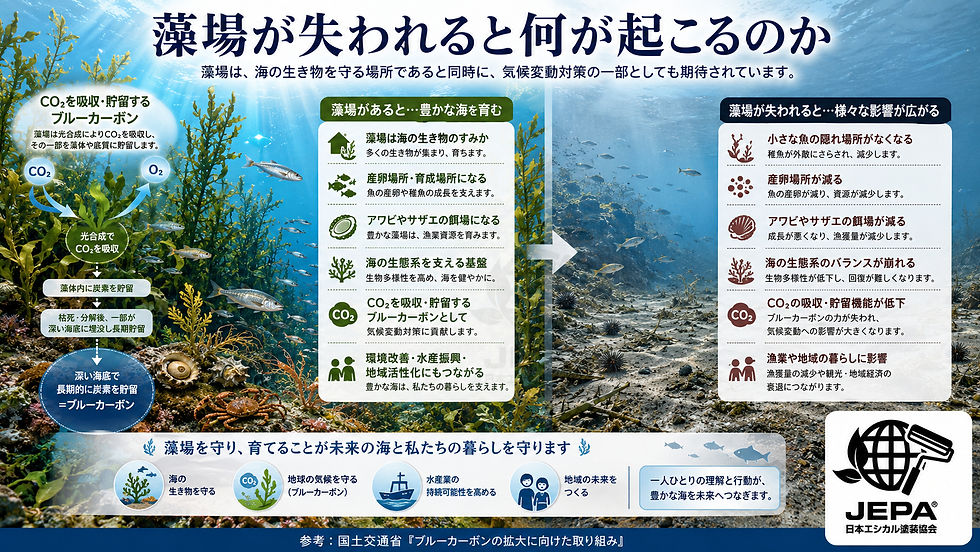
藻場が失われると何が起こるのか
藻場が失われると、まず影響を受けるのは海の生き物たちです。
小さな魚の隠れ場所がなくなる。産卵場所が減る。アワビやサザエなどの餌場が減る。海藻を食べる生き物のバランスが崩れる。それを食べる魚や人間の暮らしにも影響が出る。
藻場は、単なる海藻の集まりではありません。
海の生態系を支える基盤です。
そして近年では、藻場はブルーカーボンの観点からも重要視されています。
海藻や海草は、光合成によって二酸化炭素を取り込みます。その一部は、海底や深い海へ移動し、長期的な炭素貯留につながると考えられています。
国土交通省のブルーカーボン資料では、藻場・干潟などが形成されることで、CO₂吸収、環境改善、生態系創出、水産振興、環境学習、地域活性化などにつながることが示されています。参考:国土交通省「ブルーカーボンの拡大に向けた取り組み」
つまり藻場は、海の生き物を守る場所であると同時に、気候変動対策の一部としても期待されているのです。
一般社団法人日本エシカル塗装協会の取り組み
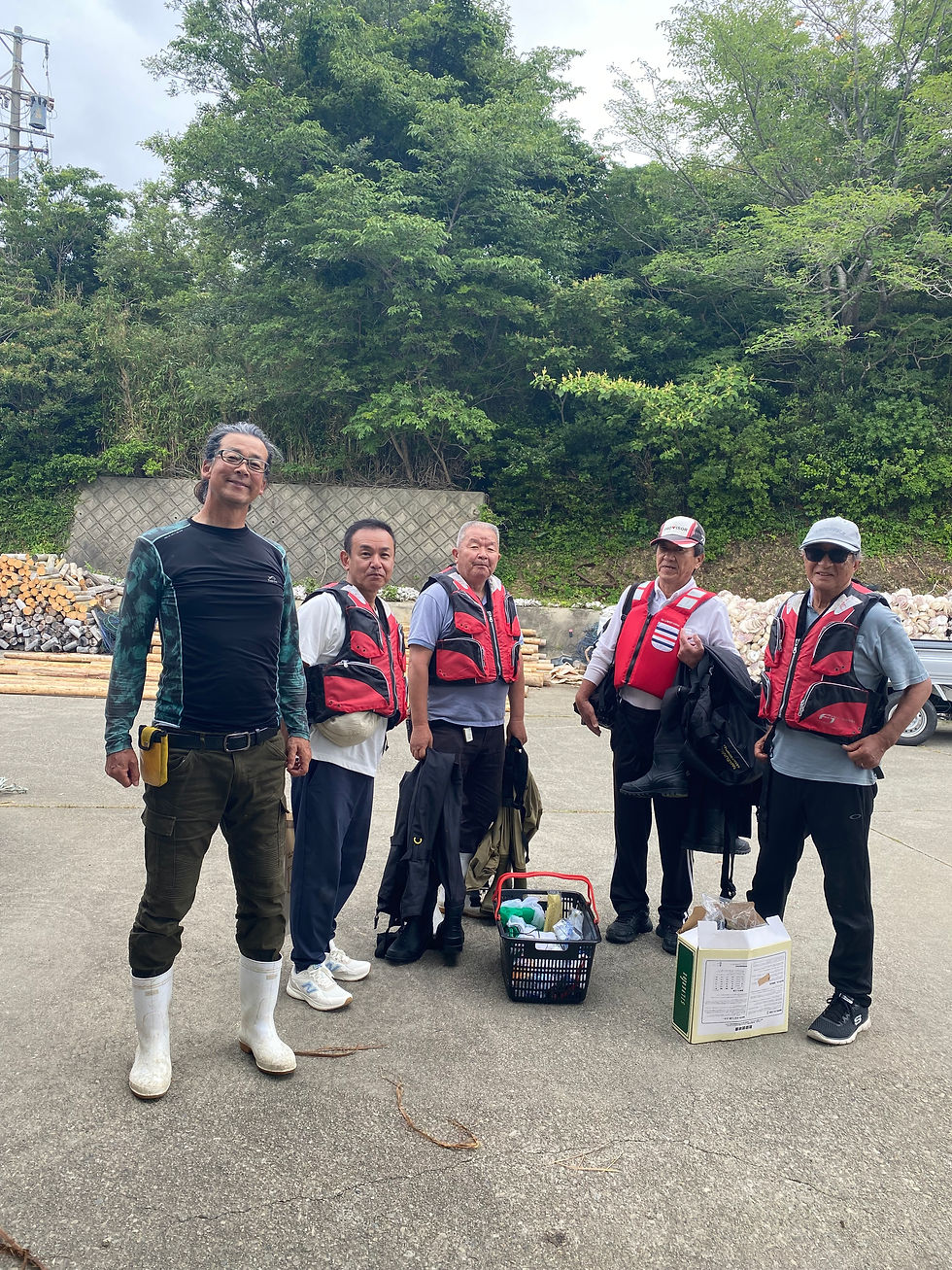
一般社団法人日本エシカル塗装協会では、海の環境再生に関わる取り組みの一つとして、カジメ藻場の生息状況を確認する調査プロジェクトへの協力を始めました。
これは、カジメをカゴの中で管理し、一定期間後にどのように変化するのかを確認していく取り組みです。
増えるのか。減るのか。食害の影響はあるのか。その場所の環境で生育できるのか。
こうした小さな観察を積み重ねることで、今の海の状態を知る手がかりになります。
私たちは専門研究機関ではありません。
しかし、海の変化に危機感を持ち、調査団体や地域の取り組みに支援・協力することはできます。
塗装業界は、建物を守る仕事です。
しかし、これからの時代は、建物だけでなく、地域、海、森、未来の環境にも目を向ける必要があると考えています。
同じ三重県内では、鳥羽市の海の博物館でも、アマモやコアマモの藻場保全活動が紹介されています。カジメとは種類が異なりますが、藻場を守る活動が地域の海の環境を考えるうえで重要であることを示す事例の一つです。参考:海の博物館「藻場保全活動」

カゴを使わなければ守れないという現実
今回の取り組みでは、カジメをカゴの中で管理して調査します。
これは、裏を返せば、自然のままでは食害などの影響を受けやすい可能性があるということでもあります。
もちろん、原因を一つに決めつけることはできません。
食べる生き物が悪いわけでもありません。
本来、海の中には食べるものと食べられるもののバランスがあります。
しかし、海水温の上昇や環境変化によってそのバランスが崩れると、特定の生き物の食圧が強くなり、海藻が回復しにくくなることがあります。
水産庁の資料では、磯焼け対策として、植食性魚類から海藻を守るための防御や、必要に応じた除去なども紹介されています。これは、現場によっては「海藻を植える」だけではなく、「食べられないように守る」ことも重要になることを示しています。参考:水産庁「海水温上昇に対応した藻場造成について」
もし、カゴの中では育つのに、カゴの外では育たないとしたら。
そこには、今の海が抱えている問題が見えてくるかもしれません。

何十年後の海を想像する
もし藻場が減り続けたら、海はどうなるのでしょうか。
魚が減るかもしれません。貝が育ちにくくなるかもしれません。磯の生態系が変わるかもしれません。海の水質や炭素循環にも影響が出るかもしれません。
もちろん、未来を正確に予測することは簡単ではありません。
しかし、過去と現在を比べることで、変化の方向は見えてきます。
昔はあった藻場が、今はない。昔は少なかった食害が、今は目立つ。昔より海水温が高くなっている。地域によって残っている藻場と消えている藻場がある。
こうした事実を見つめることが、未来への第一歩になります。
環境省の資料でも、海水温上昇を踏まえた磯焼け対策として、深場や河口周辺など海水温上昇が抑えられている場所の活用、高水温下でも生育可能な海藻種の活用などが議論されています。参考:環境省資料「日本全国の磯焼け対策について」
塗装と海は、無関係ではない
一見すると、塗装と藻場は関係がないように見えるかもしれません。
しかし、私たちはそうは考えていません。
外壁塗装は、建物を長持ちさせる仕事です。建物を長持ちさせることは、塗り替え回数を減らし、資源や廃棄物、二酸化炭素の削減にもつながります。
一方、藻場は海の中で生き物を育て、炭素を取り込み、海の環境を支えています。
どちらも、未来を守る仕事です。
だからこそ、日本エシカル塗装協会では、塗装を通じた環境配慮だけでなく、海や森の再生にも関心を持ち、できることから取り組んでいきます。
環境省も、ブルーカーボンについて、気候変動対策や生態系保全の観点から取り組みを進めています。参考:環境省「ブルーカーボンに関する取組」

まとめ
カジメ藻場の変化は、海の中で静かに進んでいる環境変化の一つです。
海水温上昇。磯焼け。食害。藻場の減少。ブルーカーボン。水産資源への影響。
これらは、別々の問題ではありません。
海の環境、気候変動、地域の漁業、私たちの暮らしは、すべてつながっています。
日本エシカル塗装協会は、カジメ藻場の調査協力を通じて、海の変化を知り、学び、伝えていきます。
大きなことは、すぐにはできないかもしれません。
しかし、まずは知ること。現場を見ること。記録すること。支援すること。そして、多くの人に伝えること。
それも、未来の海を守るための大切な一歩だと考えています。
参考リンク
気象庁「海面水温の長期変化傾向(日本近海)」https://www.data.jma.go.jp/kaiyou/data/shindan/a_1/japan_warm/japan_warm.html
水産庁「海水温上昇に対応した藻場造成について」https://www.jfa.maff.go.jp/j/seibi/attach/pdf/R7_isoyake_kyogikai-15.pdf
水産庁「海水温上昇に対応した磯焼け対策」https://www.jfa.maff.go.jp/j/seibi/attach/pdf/R6_isoyake_kyogikai-13.pdf
環境省資料「日本全国の磯焼け対策について」https://www.env.go.jp/council/content/i_13/000281920.pdf
国土交通省「ブルーカーボン」https://www.mlit.go.jp/kowan/kowan_tk6_000069.html
国土交通省「ブルーカーボンの拡大に向けた取り組み」https://www.mlit.go.jp/kowan/content/001981646.pdf
環境省「ブルーカーボンに関する取組」https://www.env.go.jp/earth/ondanka/blue-carbon-jp.html
海の博物館「藻場保全活動」https://www.umihaku.com/works/moba.php
#藻場再生 #カジメ #磯焼け #ブルーカーボン #海の森 #海水温上昇 #気候変動 #海洋環境 #食害対策 #水産資源 #アマモ場 #海藻藻場 #エシカル塗装 #日本エシカル塗装協会 #環境保全 #未来の海を守る
What Can We Do in an Age When the Forests of the Sea Are Disappearing?
Understanding Ocean Warming, Barren Grounds, and Blue Carbon Through Our Cooperation in Kajime Seaweed Bed Research
There are forests beneath the sea.
Just as forests on land are formed by trees, forests in the sea are formed by seaweeds and seagrasses. These underwater forests are known as “seaweed beds” or “seagrass beds.”
Seaweed beds provide habitats for fish, shellfish, shrimp, crabs, and many small marine organisms.They also serve as spawning grounds for fish and nursery areas where young fish can grow.They help maintain the quality of seawater.In recent years, they have also attracted attention as blue carbon ecosystems that absorb and store carbon dioxide.
The Ministry of Land, Infrastructure, Transport and Tourism introduces blue carbon ecosystems such as seaweed beds and tidal flats not only as carbon dioxide absorption sources, but also as ecosystems with multiple values, including improvement of the marine environment, creation of ecosystems, support for fisheries, environmental education, and regional revitalization.Reference: Ministry of Land, Infrastructure, Transport and Tourism, “Blue Carbon”
However, seaweed beds in many areas around Japan are now undergoing major changes.
Seaweeds are decreasing.The seafloor is becoming whitish.Feeding damage by fish and sea urchins is becoming more noticeable.Seaweed beds that once existed are no longer seen.
This phenomenon is called “isoyake,” or barren ground formation, and it has become a nationwide issue.
Documents from the Fisheries Agency of Japan also describe barren grounds as a serious problem that has a major impact on fisheries and coastal ecosystems.Reference: Fisheries Agency of Japan, “Vision for Seaweed Beds and Tidal Flats”

What Is Kajime?
Kajime is a large brown seaweed closely related to kelp.
It spreads through the sea like a forest and provides habitats and feeding grounds for many marine organisms.
Seaweed beds formed by large seaweeds such as kajime are extremely important for coastal ecosystems.
However, in recent years, seaweed beds including kajime have been reported to be decreasing or declining in many areas.
There is not just one cause.
Rising seawater temperatures.Damage to seaweeds caused by high water temperatures.Feeding damage by rabbitfish, sea chubs, parrotfish, sea urchins, and other herbivorous organisms.Changes in ocean currents such as the Kuroshio Current.Changes in nutrients, water clarity, seafloor conditions, and other environmental factors.
These factors are thought to interact in complex ways and contribute to the decline of seaweed beds.
Materials from the Fisheries Agency of Japan on seaweed bed creation in response to rising seawater temperatures introduce measures such as selecting suitable seaweed species, preventing feeding damage, protection methods, and removal of herbivorous organisms as part of barren ground countermeasures.Reference: Fisheries Agency of Japan, “Seaweed Bed Creation in Response to Rising Seawater Temperatures”
Changes Taking Place in the Seas Around Japan
Seawater temperatures around Japan have been rising over the long term.
According to the Japan Meteorological Agency’s “Long-Term Trends in Sea Surface Temperature,” the average sea surface temperature in the seas around Japan has been rising over the long term. The rate of increase up to 2025 is reported to be +1.36°C per 100 years.Reference: Japan Meteorological Agency, “Long-Term Trends in Sea Surface Temperature Around Japan”
When seawater temperatures rise, seaweeds may become less able to grow.
In particular, seaweeds such as kajime can weaken, die back, or be washed away when exposed to high water temperatures.
In addition, rising seawater temperatures may allow herbivorous fish, whose activity used to weaken during winter, to remain active for longer periods.
In other words, seaweeds may not only be weakened by high temperatures, but may also be more strongly affected by fish and sea urchins that feed on them.
This is not simply a matter of “the sea becoming a little warmer.”
It means that the balance within the sea is changing.
Fisheries Agency materials on barren ground countermeasures also identify protection from and removal of herbivorous fish and sea urchins, as well as the selection of appropriate seaweed species, as important elements in response to rising seawater temperatures.Reference: Fisheries Agency of Japan, “Barren Ground Countermeasures in Response to Rising Seawater Temperatures”
What Happens When Seaweed Beds Are Lost?
When seaweed beds are lost, the first to be affected are the living creatures of the sea.
Small fish lose their hiding places.Spawning grounds decrease.Feeding grounds for abalone, turban shells, and other shellfish decline.The balance among organisms that feed on seaweeds is disrupted.This can eventually affect the fish that depend on them, as well as human life and local fisheries.
A seaweed bed is not simply a collection of seaweeds.
It is a foundation that supports marine ecosystems.
In recent years, seaweed beds have also become important from the perspective of blue carbon.
Seaweeds and seagrasses absorb carbon dioxide through photosynthesis.A portion of that carbon is thought to move to the seafloor or deeper ocean, contributing to long-term carbon storage.
Documents from the Ministry of Land, Infrastructure, Transport and Tourism show that the formation of seaweed beds and tidal flats can contribute to CO₂ absorption, environmental improvement, ecosystem creation, fisheries promotion, environmental education, and regional revitalization.Reference: Ministry of Land, Infrastructure, Transport and Tourism, “Initiatives to Expand Blue Carbon”
In other words, seaweed beds are places that protect marine life and are also expected to play a role in climate change countermeasures.
The Efforts of the Japan Ethical Painting Association
As part of its activities related to marine environmental regeneration, the Japan Ethical Painting Association has begun cooperating with a research project that observes the habitat conditions of kajime seaweed beds.
This project manages kajime inside protective cages and observes how it changes over a certain period of time.
Will it increase?Will it decrease?Is it affected by feeding damage?Can it grow in that local environment?
By accumulating these small observations, we can gain clues about the current condition of the sea.
We are not a specialized research institution.
However, we can feel a sense of urgency about changes in the sea and support or cooperate with research groups and local initiatives.
The painting industry is a profession that protects buildings.
But in the years ahead, we believe it will also be necessary to pay attention not only to buildings, but also to local communities, oceans, forests, and the future environment.
In the same Mie Prefecture, the Toba Sea-Folk Museum introduces conservation activities for eelgrass and dwarf eelgrass beds. Although these are different from kajime, they are examples showing that protecting seaweed and seagrass beds is important when considering the marine environment of local regions.Reference: Toba Sea-Folk Museum, “Seaweed Bed Conservation Activities”
The Reality That Protection May Be Needed
In this project, kajime is managed inside cages for observation.
Looking at it another way, this may suggest that, in the natural environment, kajime may be vulnerable to feeding damage and other pressures.
Of course, the cause cannot be reduced to just one factor.
The creatures that eat seaweed are not “bad.”
In the natural ocean, there is a balance between organisms that eat and organisms that are eaten.
However, when that balance is disrupted by rising seawater temperatures or environmental changes, the feeding pressure from certain organisms can become stronger, making it difficult for seaweeds to recover.
Fisheries Agency materials introduce protection from herbivorous fish and, where necessary, removal of herbivorous organisms as part of barren ground countermeasures. This shows that, depending on the site, it may not be enough simply to plant seaweeds. It may also be important to protect them from being eaten.Reference: Fisheries Agency of Japan, “Seaweed Bed Creation in Response to Rising Seawater Temperatures”
If kajime can grow inside a cage but cannot grow outside the cage, that may reveal part of the problem that today’s sea is facing.
Imagining the Sea Decades from Now
What will happen to the sea if seaweed beds continue to decline?
Fish may decrease.Shellfish may become harder to grow.The rocky shore ecosystem may change.Water quality and carbon circulation in the sea may also be affected.
Of course, it is not easy to predict the future accurately.
However, by comparing the past with the present, we can begin to see the direction of change.
Seaweed beds that once existed are now gone.Feeding damage that used to be less noticeable is now becoming more visible.Seawater temperatures are higher than before.Some regions still have remaining seaweed beds, while others have lost them.
Facing these facts is the first step toward the future.
Materials from the Ministry of the Environment also discuss barren ground countermeasures that take rising seawater temperatures into account, such as using deeper waters or areas near river mouths where temperature increases may be more moderate, and utilizing seaweed species that can grow under high-temperature conditions.Reference: Ministry of the Environment, “Barren Ground Countermeasures Across Japan”
Painting and the Sea Are Not Unrelated
At first glance, painting and seaweed beds may seem unrelated.
However, we do not see it that way.
Exterior painting is a profession that helps buildings last longer.Helping buildings last longer can reduce the number of repainting cycles, which can also lead to reductions in resources, waste, and carbon dioxide emissions.
On the other hand, seaweed beds nurture marine life, absorb carbon, and support the marine environment.
Both are forms of work that protect the future.
That is why the Japan Ethical Painting Association is interested not only in environmental consideration through painting, but also in the regeneration of oceans and forests, and is working on what we can do step by step.
The Ministry of the Environment is also promoting initiatives related to blue carbon from the perspectives of climate change countermeasures and ecosystem conservation.Reference: Ministry of the Environment, “Initiatives Related to Blue Carbon”
Conclusion
Changes in kajime seaweed beds are one of the environmental changes quietly taking place beneath the sea.
Rising seawater temperatures.Barren grounds.Feeding damage.Decline of seaweed beds.Blue carbon.Impacts on fisheries resources.
These are not separate issues.
The marine environment, climate change, local fisheries, and our daily lives are all connected.
Through cooperation in kajime seaweed bed research, the Japan Ethical Painting Association will continue to learn about changes in the sea, study them, and share them with others.
We may not be able to do something large immediately.
But first, we can learn.We can observe the field.We can record what is happening.We can provide support.And we can share this information with many people.
We believe that this, too, is an important step toward protecting the sea of the future.
Reference Links
Japan Meteorological Agency, “Long-Term Trends in Sea Surface Temperature Around Japan”https://www.data.jma.go.jp/kaiyou/data/shindan/a_1/japan_warm/japan_warm.html
Fisheries Agency of Japan, “Vision for Seaweed Beds and Tidal Flats”https://www.jfa.maff.go.jp/j/gyoko_gyozyo/g_thema/attach/pdf/sub53-6.pdf
Fisheries Agency of Japan, “Seaweed Bed Creation in Response to Rising Seawater Temperatures”https://www.jfa.maff.go.jp/j/seibi/attach/pdf/R7_isoyake_kyogikai-15.pdf
Fisheries Agency of Japan, “Barren Ground Countermeasures in Response to Rising Seawater Temperatures”https://www.jfa.maff.go.jp/j/seibi/attach/pdf/R6_isoyake_kyogikai-13.pdf
Ministry of the Environment, “Barren Ground Countermeasures Across Japan”https://www.env.go.jp/council/content/i_13/000281920.pdf
Ministry of Land, Infrastructure, Transport and Tourism, “Blue Carbon”https://www.mlit.go.jp/kowan/kowan_tk6_000069.html
Ministry of Land, Infrastructure, Transport and Tourism, “Initiatives to Expand Blue Carbon”https://www.mlit.go.jp/kowan/content/001981646.pdf
Ministry of the Environment, “Initiatives Related to Blue Carbon”https://www.env.go.jp/earth/ondanka/blue-carbon-jp.html
Toba Sea-Folk Museum, “Seaweed Bed Conservation Activities”https://www.umihaku.com/works/moba.php
#SeaweedBedRestoration #Kajime #BarrenGrounds #BlueCarbon #ForestsOfTheSea #RisingSeawaterTemperatures #ClimateChange #MarineEnvironment #FeedingDamageCountermeasures #FisheriesResources #EelgrassBeds #SeaweedBeds #EthicalPainting #JapanEthicalPaintingAssociation #EnvironmentalConservation #ProtectTheFutureSea

コメント